The Theory of Related-ivity: Segment XV
Friday, April 17, 2026 - 09:00
The Theory of Related-ivity:
A History and Analysis of the Best Related Work Hugo Category
by Heather Rose Jones
(This is a serialized article exploring the history of the Best Related Work Hugo category in its various names and versions. If you’ve come in at the middle, start here.)
Contents
Part 3: Historic Trends
3.4 Other Tags
3.4.1 Introduction
3.4.2 People
3.4.3 Properties
3.4.4 Other Topics
3.4.5 Publishers
3.4.6 Series
Part 3: Historic Trends
3.4 Other Tags
3.4.1 Introduction
Several types of data were tracked that only occur sporadically. Therefore, this section provides more anecdotal observations than solid trends. Only in the case of People (both as authors and as Topics) is there an analysis by era. Due to the nature of this data, comparisons of the three eras have not always been done.
3.4.2 People
Named People appear in the data set in two contexts: as authors (or editors or other contributors) and as subjects. Overall 581 individuals appear in one or the other function, 536 as authors and 118 as subjects, with 74 of them appearing in both functions.
Repeat authors are common with 123 (23%) authors appearing more than once.[1] Four People appear as authors 10 or more times. Arnie and Cathy Fenner appear together 17 times as editors of the Spectrum Art volumes. Farah Mendlesohn appears 12 times as author or editor of works of Criticism, Essays, Biography, and History. John Clute appears 10 times as author primarily of Reference works, but also of Criticism, Essays, and Reviews. Other authors appearing 4 or more times are:
- Algis Budrys (Criticism, Fiction, Reviews)
- Andrew M. Butler (Criticism, Essays, History)
- Brandon Sanderson (Craft, all related to the Writing Excuses Podcast)
- Dan Wells (Craft, all related to the Writing Excuses Podcast)
- Dave Langford (Essays, Criticism, Reviews, Fiction, Reference)
- Edward James (Essays, Criticism, History, Biography)
- Gary K. Wolfe (Reviews, Criticism, Essays)
- Harlan Ellison (Essays, Criticism, Graphic, Art)
- Howard Taylor (Craft, all related to the Writing Excuses Podcast)
- Isaac Asimov (Autobiography, Letters, Fiction)
- James E. Gunn (Biography, Autobiography, Reference, Essays)
- Jeff VanderMeer (Craft, History, Art, Fiction)
- John Scalzi (Essays, Criticism, Craft)
- Jordan Sanderson (Craft, all related to the Writing Excuses Podcast)
- Mary Robinette Kowal (Craft related to the Writing Excuses Podcast, plus Science)
- Mike Ashley (History)
- Mike Resnick (Craft, Convention Publications)
- Neil Gaiman (Graphic, Essays, Criticism, Fiction)
- Paul Kincaid (Criticism, History, Biography)
- Robert Silverberg (Essays, Autobiography, Interviews)
- Ursula K. LeGuin (Essays, Craft, Criticism, Reviews)
Repeat named-individual subjects are also common, with 33 individuals (28% of Person-subjects) appearing more than once in this function. The most common People appearing as subjects (those appearing 4 or more times) are: Isaac Asimov, Robert A. Heinlein, J.R.R. Tolkien, and Octavia Butler.
When the functions as author and subject are combined, additions to the repeat-appearance list (with 4 or more appearances in either function) besides those mentioned previously are:
- Bob Eggleton
- Brian Aldiss
- David A. Cherry
- Diane Dillon
- Iain M. Banks
- Jack Williamson
- Joanna Russ
- John Picacio
- Leo Dillon
- Michael Whelan
- Philip K. Dick
- Samuel R. Delany
- Shaun Tan
- Stephen King
- Terry Pratchett
- Ursula Vernon
- Vincent DiFate
For gender comparisons, a different baseline is used than in previous discussions, due to the difficulty in teasing out calculations involving multi-author works. Here a simple count of distinct persons named in any function in the overall data set is used:
- Male 413 (71%)
- Female 156 (27%)
- Non-Binary 8 (1%)
This is a different way of looking at the data than that seen in the General Trends section under Gender, which calculated the proportions in terms of works.[2]
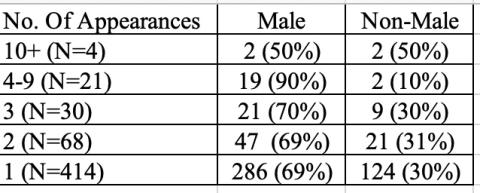
Although there is an even gender balance among the most common authors (10+ appearances), authors appearing 4-9 times are heavily skewed towards male authors (90%), with authors appearing at lower frequencies running consistently around 70% male, in line with the overall percentages.
Table 20: Repeating Authors by Gender
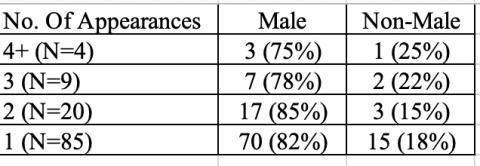
A similar analysis for the gender of Topics shows a slightly reversed pattern with the proportion of male Topics increasing from a level roughly similar to overall representation, to higher levels of male subjects with decreasing frequency of appearance.[3]
Table 21: Repeating Topics by Gender
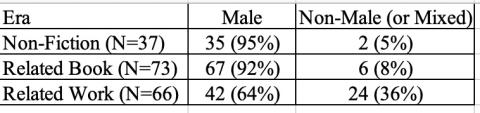
For Topics, it’s easier to also do a comparison across different eras, although it isn’t broken down by repeat appearances due to the small numbers. Male Topics predominate heavily in the first two eras and remain at 2 out of 3 in the most recent era, though this is less male-skewed than the overall named-person dataset.
Table 22: Proportion of Gendered Topics by Era
Conclusions
Both as authors and as subjects, the distribution of People follows a typical “long tail” distribution. The types of Categories associated with repeating authors is quite varied, but unsurprisingly corresponds largely to the “most popular” and “more popular” groups. Gender distribution behaves differently for the two functions, with repeat authors skewing male (except at the very highest numbers, thanks to 2 very prolific individuals), while the percentage of male subjects is more balanced for repeat subjects, then skews more heavily male at lower frequency of appearance. In other words, male authors are more likely to get multiple nominations, while non-male individuals are slightly more likely to be the subjects of multiple nominated works, entirely due to the increase in non-male Topics during the Related Work era. This matches other measures of gender balance which shows a shift from male dominance in earlier years to a fairly recent approach to parity.
3.4.3 Properties
Works were tagged for Property when the Topic of a work is a single specific media Property.[4] There were 59 works (10% of the dataset as a whole) tagged for 33 distinct Properties, of which 9 Properties appeared more than once.[5] The Properties appearing more than once are:
- Doctor Who (6)
- Star Trek (6)
- Discworld (5)
- Star Wars (5)
- Lord of the Rings (4)
- Game of Thrones (3)
- Dune (2)
- Harry Potter (2)
- The Hobbit (2)
Six of these originated as print fiction, although the nominated works may concern derivative video material (tv and movie versions), while the remaining 3 originated as video formats.[6] There’s a greater variety of original formats for the full data set, including comics and games, and print-origin works make up slightly less than half of the full set.
The works take a variety of approaches to their Topics. The most common Category was Criticism (15) followed by Reference (11), Art (10), and History (9). Category types with 5 or fewer examples were Essays, Craft, Graphic, Journalism, Reviews, Science, and Role-Playing Game.
For 2 of the repeating Properties, some works were part of an identifiable Series, while the other repeating Properties involved all independent works. Doctor Who had 3 works from the “Chicks Dig” Series and 2 works from Doctor Who: The Writer’s Tale. Discworld had 3 works from the Science of Discworld Series.
Male-only authorship was 58%, non-male only authorship was 34%, while mixed authorship was 5%, showing a slight skewing of authorship towards non-male compared to the dataset as a whole, but this is entirely due to the gender make-up during the Related Work era, where male-only authorship was 35%. In the other two eras, proportions matched the dataset as a whole.
Property-tagged works made up the following percentages in each era:
- Non-Fiction 5% of Finalists
- Related Book 3% of Finalists, 12% of Long List
- Related Work 10% of Finalists, 10% of Long List
In other words, while works about specific Properties appear to be nominated in relatively steady proportions (within the limits of the data set), they have increased in popularity to make Finalist more often in the most recent era. It’s possible that this is related in some way to the expanded format scope, as nearly half of the works in that era (46%) are non-Book formats. If so, the effect would be related to a shift in interest from Books to other formats, as the overall proportion on the Long List is similar to the previous era. It’s also possible that the increased interest is due to some other correlating factor such as author gender.
Only one Property-tagged work has won Best Related: Chicks Dig Time Lords: A Celebration of Doctor Who by the Women Who Love It.[7]
Conclusions
Overall, works related to specific media Properties make up a small but meaningful percentage of nominees, but have only been recognized as Finalists in proportion to their numbers in recent years. The works discuss their subjects through a variety of lenses and using a variety of Media formats. Author gender followed the overall proportions in the earlier two eras but skewed away from all-male authorship in the Related Work era at the same time that interest shifted from Books to other formats.
3.4.4 Other Topics
In addition to tagging works for the Person or Property that is the subject, a reasonable attempt has been made to identify other types of Topic. This may be in addition to a Person/Property tag, in rare cases. Rather than attempting to define a relatively closed set of Topics, the tags have been chosen expansively and only afterwards normalized to combine what are clearly close variants of the same theme.
After excluding works that are tagged only for Person or Property, or which are identified as concerning multiple Persons, or are a multi-genre collection of the work of a single author, the following interesting themes emerge from the remaining 272 works.
A large number (61) focus on specific textual genres, especially the broad genres of science fiction and fantasy, but also including micro-genres such as steampunk, pulp fiction, and the Omegaverse.
Topics related to the process of writing and publishing are also well represented (34), mostly as a general Topic, but including specifics such as magazines, the business of writing, and tropes.
In similar numbers we find Topics related to representation (31), either on the page or from the creator side. Especially prominent are works relating to feminism and the representation of women, racial representation, and disability.
Next we have Topics related to the culture of fandom and conventions (25). Topics on various artistic media (18) include studies or techniques related to specific formats such as movies, graphic art, and anime. Various Topics relate to space (18), including both astronomy and speculative works on space travel and space stations. 15 works focus on the literature of specific countries, regions, or languages. Hard sciences and technology works (14) include factual Science and speculative extrapolations such as robots and futurism.
Topic groups consisting of 5-10 works include myth and legend, gaming, life sciences, industry awards, material culture/artifacts, and several Topics falling generally under philosophy.
There are no overall conclusions to this chapter, given the broad scope of the Topics and the small data numbers.
3.4.5 Publishers
Identifying the Publisher of each work isn’t entirely straight-forward, therefore this discussion is an approximation. Publisher data is taken either from the official Hugo website data or from Wikipedia, Goodreads, or Internet Archive data. But disentangling different editions, different Publisher imprints, and determining whether to lump imprints together under a Publisher—to say nothing about tracking mergers and acquisitions—goes beyond the scope of this project. In some cases, it’s possible that listings have been lumped together as variants on a Publisher name that, in fact, represent different Publishers or different imprints with similar names. There’s also the question of what to identify as the “Publisher” of personal Blogs, Social Media accounts, and YouTube channels.
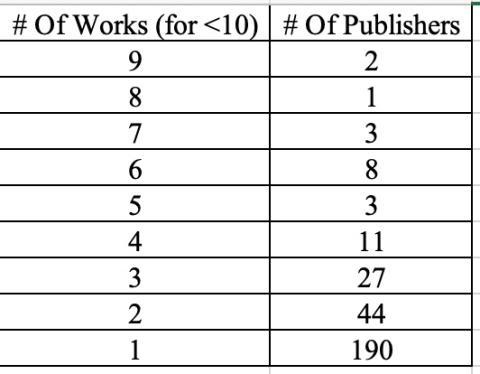
Given the preceding, the data identifies 294 different Publishers. Only absolute numbers are analyzed, not changes over time. Five Publishers appear 10 or more times:
- Underwood Books (26)—Primarily Art Books, especially the Spectrum Series
- Paper Tiger Books (15)—Art Books
- Tor Books (12)—A variety of content
- NESFA Press (11)—A variety of content, primarily Essay collections
- McFarland & Company (10)—A variety of content, primarily Biography
For Publishers appearing fewer than 10 times, we see a typical “long tail” distribution, indicating that Publisher distribution is relatively random.
Table 23: Repeating Publishers
University Presses
One might expect that university presses would be well represented for the more academic works, however they are only a minor fraction. There are 19 different Publishers with the word “university” in the name, representing 48 works. The university presses aren’t limited to the most scholarly Content. In addition to Biography, Craft, Criticism, Essays, History, and Reference works, they also publish Reviews and Interviews. The most common content types not published by university presses are: Art, Autobiography, and Fiction.
Author gender for university press publications is less skewed towards male authors than the dataset as a whole, with 56% all-male authorship, 33% all non-male authorship, and 10% mixed.
No other subsets of Publisher have been analyzed further.
3.4.6 Series
Nominators are fond of following thematic Series of works. In the data set, 93 works (15% of the dataset) are identified as belonging to a Series of publications, representing 37 different Series. (Of which 14 are represented by only a single nominee.) Series with 3 or more nominations are as follows:[8]
- The Spectrum annual Art showcases (17 works)
- The Modern Masters of Science Fiction Series from the University of Illinois Press (6 Biographies)
- The Chicks Dig… Series from Mad Norwegian Press (5 volumes of Essays covering female fandoms of specific Properties)[9]
- The Writing Excuses Podcast (5 years)
- The #BlackSPecFic Report (4 years)
- The Anatomy of Wonder (3 separate editions)
- The Cambridge Companions to Literature Series from the University of Cambridge Press (3 nominees, but two are the same work with an extended eligibility)
- Chinese Science Fiction, An Oral History (3 volumes in various combinations)
- Jim Hines’s Invisible Essay collection Series on marginalized representation (3 years)
- The Science of Discworld (3 volumes)
- Writers of the Future (3 volumes, although one was explicitly ruled ineligible as Fiction and it’s likely the other two would have been as well, if evaluated)
The following Series have two works in the data set:
- Reader’s Guide (genre survey)
- Doctor Who: The Writer’s Tale (insider analysis of the show)
- Dream Makers (Biography collections)
- Faces of… (Photography of figures in the field)
- I, Asimov (Autobiography)
- Liverpool Science Fiction Texts and Studies (both works are histories of pulp magazines)
- Robert A. Heinlein: In Dialogue with His Century (Biography)
- Sandman (Graphic novel)
- Science Fiction, Fantasy, and Horror (annual books in print report)
- Speculative Fiction: The Year’s Best Online Reviews, Essays, and Commentary
- The Encyclopedia of Science Fiction (2 different editions)
- Tropes vs. Women in Video Games (Video Essays)
As seen above, works appearing as part of a Series represent a wide variety of content Categories and (in the Related Work era) Media formats. As such, further analysis would be unlikely to provide meaningful results.
(Segment XVI will cover Part 4 Conclusions, Section 4.1 Thoughts on Categories and Eligibility and Section 4.2 Summary.)
[1]. That is, this represents 23% of the distinct authors, not 23% of the works. Similarly for People-subjects below.
[2]. The more complicated calculation for comparing the different eras hasn’t been performed, but based on the gender fractions per work comparison, we would expect to see a similar gradient with male dominance decreasing over time.
[3]. There are some flaws to using the full set of named people as the reference point, as it assumes that out of a random pool of participants a person is equally likely to be an author or subject of a work. This is clearly not the case, but it would be much harder to identify gender balance in the potential pool of subjects.
[4]. This does not include works where the work is the Property. For example, a critical study of Batman comics would count as Batman being the Property, while the nomination of Batman: The Dark Knight Returns itself does not count.
[5] As with multi-author collections, the Properties mentioned in multi-Topic collections are not individually tagged.
[6] All of these Properties have some video presence, although it isn’t clear that Discworld nominees benefitted from the associated video works.
[7]. The repeated appearance of works in the Chicks Dig… Series inspires one hypothesis for the gender skewing in the Related Work era. Possibly as part of overall gendered trends, non-male authors are more interested in producing fannish Analysis of specific Properties.
[8] Ongoing projects, such as Podcasts or certain types of Websites have not been included as a Series.
[9]. I have included one work in this Series titled Queers Dig… as there doesn’t seem to be a good, simple umbrella label for the whole series.
Major category: