Blog
Saturday, May 2, 2026 - 07:00
Lesbian Historic Motif Podcast - Episode 341 - On the Shelf for May 2026 - Transcript
(Originally aired 2026/05/02)
Welcome to On the Shelf for May 2026.
Well, it’s now been an entire year since my retirement. You know that feeling after some significant life change where it seems like it only happened yesterday even though it’s been a while? I feel like that about the last time I moved—it was back in 2011 but continues to feel very recent. But retirement—it feels like I’ve been retired forever and it’s hard to remember life with day-job. I mean, I sometimes have flashes of memory: “Oh right, commuting in to Berkeley, stopping at the bakery for a pastry, meetings, doing walk-throughs of production equipment, diving deep into writing reports” but it’s sort of like a dream now. I meant to keep more in touch with my former co-workers, but time slips away and my focus is on all my projects, my bicycling, and my garden.
A chat recently with one of my authors for the fiction series reminded me that it’s time to set up the call for submissions page for this year. The call for submissions from last year is still linked in the web site menus, and nothing significant will change, so there’s no reason to put off writing. As I’ve mentioned previously, 2027 will be the last year I run the fiction series, finishing off a 10 year run. The podcast itself will keep running as long as I can keep coming up with things to say.
News of the Field
It probably isn’t too early to mention that I’ll be attending the Golden Crown Literary Society conference this year. If you’ll be there too, please do hunt me down to say hi. I don’t yet know if I’ll be on any programming, but I hope to take the opportunity to record some interviews, if the stars align.
Publications on the Blog
On the blog, although I got distracted from posting articles for a while by a non-lesbian project, I binged a bit in the last week to get caught up with the ones I had written up. Valerie Traub’s “The Perversion of ‘Lesbian’ Desire” is a precursor for a chapter in her book The Renaissance of Lesbianism, but it was worth revisiting the material in a little more detail. Because of the semi-random way I encounter publications, this is hardly the first time that I’ve blogged two different versions of an author’s work. That was also the case for Tim Hitchcock’s “Redefining Sex in Eighteenth-Century England” which, I confess, I had as many criticisms of this time as the previous read. Dawn M. Goode’s “Dueling Discourses: The Erotics of Female Friendship in Mary Pix’s ‘Queen Catharine’” was a bit tangential to sapphic themes, exploring the relationship between two female characters in a late 17th century play. Much more pertinent, from the same era, was Molly McClain’s “Love, Friendship, and Power: Queen Mary II's Letters to Frances Apsley” which reviews the very passionate sentiments in the correspondence and the social and literary context that helps us understand them. And finally, Christine Roulston’s “Separating the Inseparables: Female Friendship and Its Discontents in Eighteenth-Century France,” while mostly about gender politics in Revolution-era France, makes an unintentional point about the coded language available to talk about lesbianism that was perfectly clear to those who used it, even when sexual vocabulary wasn’t used.
When I do a library run to the University of California at Berkeley and download a hundred or so journal articles, I like to group them into thematic sets, just to make the blog a smidge less random. In the current set, I’ve already done clusters on global topics, general articles on sexuality, pornography, and finishing up this month with a set generally on early modern friendship. The other sets I have lined up, in no particular order, are: 19th century biography, classical topics, 19th century France, literature of the 17-19th centuries, medieval topics, poetry, theater-related topics, and trans-related topics. I haven’t decided which to tackle next—if you’d love me to prioritize any of these, give it a shout-out in social media.
Book Shopping!
No new book shopping for the blog—maybe. On a whim, when I was in a bookstore that didn’t have the title I was looking for, I picked up Jane Austen’s Bookshelf by Rebecca Romney, about the women novelists who influenced Austen’s writing. At least four of the relevant authors have been discussed in articles I’ve blogged, so although I’m not planning to blog this book, it’s not entirely unconnected to the Project.
Recent Lesbian/Sapphic Historical Fiction
So what are the new and recent lesbian and sapphic historicals? As usual, I’ll be condensing the cover copy a little—a few of the book blurbs were really long. I think some authors need refreshing on the concept of “elevator pitch.”
Circling back to March we have a somewhat bonkers take on Tudor royal politics in The Beheading Game by Rebecca Lehmann from Crown.
In the hours after Anne Boleyn’s beheading, she wakes to find herself unceremoniously laid to rest in a makeshift coffin, her head wrapped in linen at her knees. Anne escapes the Tower of London, sews her head back on, then sets out on a quest to kill Henry VIII before he can marry her own lady-in-waiting Jane Seymour. The stakes are high—if Jane gives birth to a rival heir, Anne’s daughter, Elizabeth, will lose her claim to the throne. Traveling the streets of London in the guise of a commoner, with the help of a prostitute who becomes a trusted friend (and perhaps something more), Anne soon realizes how little she knew about life in the real world.
Consider This My Witness by Madeline Klein sounds a bit dark—not in the horror sense, but in the tragic sense. I hope I’m not putting anyone off by that, because, by the writing in the cover copy, it looks like a very solid story.
In the fenland of 1645, Maren keeps a quiet life. She tends the fire. She mends the cloth. She says yes when yes is required. Her husband is a good man and she has always known this. It is only the distance between who she is and who she is required to be that she cannot name.
Then Alice comes. She comes with the smell of the fen on her and herbs she has been drying and a knowledge passed down through the women of this land for three generations. She comes and does not leave again. Not really. Not from the place in Maren's chest where she takes up residence in September and never moves.
The mechanism arrives that same autumn. Men with the right authority and the right questions and all the patience in the world. The witch-finder's committees are forming. The drainage engineers are cutting new channels through the mere. Everything is being remade into something it has not decided to be.
Maren watches. She stays quiet. She says yes. She will spend forty-three years learning what that cost.
The two-book series Beneath the Quiet Valley by Eleanor Foster starts out with a similar feel but sounds like it moves to a more hopeful place. I can’t tell from the cover copy exactly when and where the setting is, but it could be so many times and places.
In a quiet mining valley where lives follow the same path year after year, change is not welcomed. It is endured. Clara has spent her life doing what is expected of her. She keeps the house warm, the meals ready, and the silence gentle while her husband works the mines. It is a life built on duty, steadiness, and compromise. Until the day Betty arrives.
New to the village and trapped in a difficult marriage, Betty brings with her a restless energy the valley has never known. What begins as friendship soon becomes something deeper—something neither woman has the language to explain, but neither can deny.
The second book, Two Lives, hints at the direction that story took.
Betty believed she had already found her place in the quiet valley beside Clara — a life built on tenderness, loyalty, and a love that had grown stronger in the shadows of a watchful world. But when a journey to the coast brings an unexpected reunion with someone from Clara’s past, the fragile balance between them begins to shift. Olive is confident, independent, and carries a freedom Betty has never known. As Clara’s health slowly fades, Betty finds herself caught between devotion and desire, loyalty and possibility.
I saved one April book over to this month to coordinate with an author interview. You’ll hear more about The Mystery of the Bitten Peach by Cecilia Tan from Neon Hemlock later in this show.
Meet Mei, a young Chinese American who has discovered she has the mystical ability to transport herself anywhere that is spiritually “China”—including Chinatowns around the world and different eras of Chinese history. As an adoptive child of the diaspora, Mei was raised in America with no knowledge of Chinese folklore or fairy tales, but when an antiques dealer friend needs help retrieving a mythic artifact—a jade carving of a peach that represented same-sex love in ancient China—she’s game to give it a try. Her quest sends Mei not only into the past, but on a journey of self-discovery.
The next set of three books is being released across April and May. The cover copy is extremely long and has a lot of overlap across the three books, so I’m going to combine them into a single description. The publisher seems to specialize in “theological historical fiction” so I’m not entirely certain how the implied sapphic relationship is handled. The series title is The Woman at the Well, and the three books are The Water that Remembers, The Weight of Staying, and The Courage to Remain. The historical inspiration for the story is the tale of the Samaritan woman at Jacob’s Well in the Bible.
She went to the well at midday — when no other woman would be there. That was not recklessness. That was strategy. Leah has learned how to disappear. After five marriages and five funerals, after years of whispers that followed her through the village like a second shadow, she has perfected the art of taking up as little space as possible. She goes to Jacob's Well at the wrong hour so she won't have to feel the eyes of women who have decided what her life means. She has stopped arguing with their conclusions. She has stopped wanting much of anything.
But she has not stopped thinking about Miriam. Her connection with Miriam is tender, dangerous, and deeply human: two women finding each other in the narrow margins of a world that had no place for what they were to each other. Their love does not announce itself. It builds in stolen moments, in hands that linger a beat too long, in a kind of knowing that exists beneath language. It is the truest thing in Leah's life — and the most impossible.
Then a Jewish stranger asks her for water.
The encounter at Jacob's Well does not fix Leah. It does not save her in any simple sense. What it does is crack open something she had sealed shut — the possibility that her story is not yet over. That the woman who has survived everything might, against all probability, deserve more than survival. Because Miriam's letters are still arriving.
The encounter at the well has named the distinction between surviving and living, and Leah cannot un-hear it. Slowly, against every instinct that grief has carved into her, she begins the terrifying work of returning to herself. A choice to feel something. A letter written and sent. A decision that cannot be undone.
The May books begin with Bone of my Bone by Johanna van Veen from Poisoned Pen Press.
The year is 1635. Sister Ursula, a young nun fleeing the ruins of her convent, and Elsebeth, a sharp-witted peasant, escape a band of marauding soldiers and disappear into the Bavarian forest. War scorches the land, and no one survives it alone. Amid the devastation, they find something in the arms of a dying man: the gilded skull of a saint.
It is said that if you reunite the saint's skull with her body, a wish will be granted. Desperate for salvation, and each with secret desires of their own, Ursula and Elsebeth follow a ragged map across the blighted countryside. But darkness follows them. A necromancer, drawn to the relic's power. The saint herself, whispering at night. And as the lines between blessing and curse blur, the women must face a harrowing truth: the magic they seek comes at a cost.
At the journey's end, they'll face an impossible choice—one that could tear apart everything they know… or bind them to each other forever.
The library of Jane Austen inspired novels increases this month with Miss Woodhouse & Miss Fairfax by Maisie Jardelle. It’s described as “a steamy, sapphic retelling of Jane Austen's Emma” and it’s hard to tell whether this is “romance-novel steamy” or “basically just erotica steamy.”
Despite them being of similar age and moving in the same circles, Emma Woodhouse could never bring herself to like the cold and reserved Jane Fairfax whose accomplishments in art and music are a painful reminder of what Emma might have achieved if she applied herself instead of playing cupid for those around her.
When Emma is guilted into doing a favour for Jane, she is surprised by the warmth of Jane’s gratitude and comes to understand that what she thought was icy reserve was only painful shyness.
With Jane destined to be a governess unless she can marry well, Emma is determined to put her matchmaking skills to use. But as the search begins, Emma realises her heart isn’t in it. Instead of finding the perfect husband for Jane, she begins to harbour secret hopes of her own.
Gothic novels make up a surprising percentage of sapphic historicals and The Wives of Herrick Hall by Julie Lew from Quill & Crow Publishing House follows that trend.
After a dalliance with another woman leaves her reputation in shambles, Josephine Carter is banished to the isolated manor to serve as lady’s companion to Herrick’s mistress. Lady Nora Blake is a headstrong, capricious woman, who spends her days convalescing from a mysterious illness—and her nights witnessing her imminent death over and over. Shackled to her side, Josephine is certain life could not get worse. But then she meets the Herrick wives. Ghosts veiled in shadow stalk the halls and trespass into Josephine’s dreams, trapped forever in the fury of their last dying wish: to destroy Herrick and everyone beneath its roof. Josephine determines to escape by any means necessary.
Until she and Nora fall in love.
Together, Josephine and Nora must confront Herrick’s curse to battle their way to freedom. But Herrick has already claimed them as its next ghostly brides, and neither the house nor its vengeful wives will relinquish them without bloodshed…
Her Runaway Lady by B.J. Sikes sounds like a “poor little rich girl” fantasy that takes a realistic look at what comes of escaping a privileged life in Belle Epoque Paris. The description also mentions steampunk elements, so expect a touch of fantasy.
An ambitious young milliner. A shy noblewoman fleeing an arranged marriage. Love is a risk neither can afford.
Solange doesn't have time for love. She's too busy working her way up in the Parisian millinery trade. Her goal: to become rich and lift her family out of poverty. So when a beautiful aristo whirls into the millinery fascinated by hat making, Solange isn't interested. Or so she tells herself.
Louise-Marie hates the fancy parties she's dragged to at Versailles and never wanted to marry. She just wanted to be left alone, making hats. Running away from home to become a milliner seemed like a good idea but the life of a working-class shop girl is harder than she imagined. And her new coworker doesn't seem to like her much.
Thrown together in the cramped backroom of a millinery shop and a shared garret room, their tensions fray, tangle, then bind. But ambition doesn't leave room for longing. And love was never part of Solange's plan.
It feels like this month’s theme is “high-concept plots.” For the Love of the Quest by Alexandra Ammon Parthun from Alcove Press tosses together some unexpected elements.
Lady Edith Darling is supposed to live a quiet life in her family’s manor. She is not supposed to go unchaperoned on a quest to find Excalibur. But Edith won’t let that stand in her way, especially not when she's on this mission to honor her beloved grandmother’s dying wish. Determined to prove her grandmother right, Edith packs her satchel with Arthurian legends, pastries, and her grandmother’s ashes, and runs off to hire a mercenary.
Thomasin Shaw leads the most feared gang in London. For years, she had the constabulary safely in her pocket, until a scandal involving the chief inspector’s wife was brought to light. Now he’s demanding an enormous sum of money–without which Thomasin will lose the protection of the police along with her criminal empire. But when the rich Lady Edith waltzes into her life seeking an escort for a treasure hunt, Thomasin sees a willing kidnapping victim and a massive ransom.
As Edith’s clues lead them to underground chambers booby-trapped with arrows, doors locked with arcane puzzles, and even Arthur’s fabled round table, Thomasin finds herself swept up in the quest, and in Edith herself. Edith is also drawn to Thomasin, despite the ruthless mask she wears. But the chief inspector won’t let Thomasin forget her crimes, and Edith’s father is intent on bringing her home. Every legendary quest has an ending, but finding Excalibur might not be enough to make this a happy one.
After all that, The Summer I Met June by Mozie S from Dreamscape Studio brings us back to grounded reality.
Evelyn Abernathy is finally ready to tell the truth. She never married because her heart belonged to someone she met long ago, in a small Georgia town. Someone named June.
In the summer of 1956, June Davis walked into Evelyn's world with sun-warmed grapes, shy smiles, and the kind of kindness that made Evelyn want to be brave. What bloomed between them was gentle, forbidden, and unforgettable... until a single kiss changed everything.
Now, through memory and reflection, Evelyn returns to the season that shaped her and to the girl she never stopped loving.
What Am I Reading?
I’ve been in a bit of a slump for fiction reading lately, and I swear I haven’t gone off sapphic books as much as it seems from my reports. Lately I’ve been loving some non-fiction that touches on my special interests. The Lingthusiasm podcast (hi Gretchen and Lauren!) made me aware of Kory Stamper’s books inspired by her time working in the dictionary industry. Word by Word is a general love letter to the process of creating, revising, and maintaining dictionaries. A more specialized topic is covered in True Color: The Strange and Spectacular Quest to Define Color--from Azure to Zinc Pink. One of the things that most delighted me about these books—though it shouldn’t be a surprise—is the obvious love for the richness of language that Stamper has, not just in her subject material, but in the lovely prose she uses to talk about it. I have such a nerd-crush on her at the moment!
In an attempt to break my fiction slump, I’ve been haunting the sale listings of various audiobook sites, looking for things that catch my eye. In the past, this has resulted in sometimes buying a boxed set of audiobooks that I dropped after the first volume. (But hey, it was on sale—oh wait, maybe that’s why it was on sale.) I’ve read the first two books in Clara Benson’s Angela Marchmont mystery series: The Murder at Sissingham Hall and The Mystery at Underwood House. These are British country-house mysteries set in the era between the two world wars. I was a bit confused by the first one because, despite the series label, the protagonist was a man and the titlular Angela Marchmont was a background character—albeit one who always seemed to be two steps ahead of the supposed amateur detective. The second book switched over to Angela as viewpoint character and was more satisfactory on that point. The mysteries do have some flaws. Like: I’d figured out whodunnit very early on before the characters had any clue. And Angela has a frustrating habit of refusing to share her information and discoveries with others—including her friend the Scotland Yard detective—as she puts it “until she’s had a chance to think about it some more.” It’s a technique to keep the reader in the dark, but surely that could have been done by leaving their conversation off the page. Anyway, I’m enjoying the atmosphere and the writing otherwise and have several more to go.
But in the mean time I need to finish the copy of Tasha Suri’s The Isle in the Silver Sea that I have out from the library (which I’ll report on after I’ve finished it), and then there’s a new K.J. Charles that just dropped, so that has me set for the next while.
I used to complain a little about the number of different ebook apps I need to use to keep track of books from different sources, but now I think they’re outnumbered by the number of audiobook apps I rotate through. Since I dropped my Audible subscription, I mostly use it for sleep-listening of familiar books, though I still have a few titles there that I haven’t opened yet. I have a lot of favorites through Apple Books, and that’s my go-to for when I want to pre-order something I desperately want to own. For older public domain titles I rely on LibriVox despite the variable quality of the volunteer narrators. I use Libby for my library borrows, especially recent releases, which adds a random quality to the scheduling since I never know when a hold is going to come in, and then I feel a moral obligation to turn it around quickly so the next person can get the book. And recently I’ve added Libro.fm along with Chirp for their regular sale listings.
Libro.fm has a deal similar to that for Bookshop.org where you can designate a brick-and-mortar bookstore to get a share of the purchase price. These days Bookshop.org is my first choice for hard-copy books except in the rare case when I find myself in an actual store, and now they also have ebooks. So, folks, there are lots of alternatives to the Amazon monopoly and I will always encourage people to try them out. Those “free” (quote-unquote) reads you get from Kindle Unlimited are the honey that traps you into a system that not only gouges authors but has a very checkered track record when it comes to treating queer books fairly. This is a hill I will die on. Ahem. Moving on…
Author Guest
This month we’re happy to welcome Cecilia Tan to the show.
(Interview transcript will be added when available.)
Show Notes
Your monthly roundup of history, news, and the field of sapphic historical fiction.
In this episode we talk about:
- Say hi at GCLS
- Recent and upcoming publications covered on the blog
- Traub, Valerie. 1996. “The Perversion of ‘Lesbian’ Desire” in History Workshop Journal 41:19-49.
- Goode, Dawn M. 2008. “Dueling Discourses: The Erotics of Female Friendship in Mary Pix’s ‘Queen Catharine.’” in Restoration: Studies in English Literary Culture, 1660-1700, vol. 32, no. 1, pp. 37–60.
- McClain, Molly. 2008. “Love, Friendship, and Power: Queen Mary II's Letters to Frances Apsley” in Journal of British Studies, Vol. 47, No. 3: 505-527
- Hitchcock, Tim. 1996. “Redefining Sex in Eighteenth-Century England” in History Workshop Journal, No. 41: 72-90
- Roulston, Christine. 1998. “Separating the Inseparables: Female Friendship and Its Discontents in Eighteenth-Century France.” Eighteenth-Century Studies, vol. 32, no. 2, pp. 215–31.
- Book Shopping
- Jane Austen’s Bookshelf by Rebecca Romney
- Recent Lesbian/Sapphic Historical Fiction
- The Beheading Game by Rebecca Lehmann
- Consider This My Witness by Madeline Klein
- Beneath the Quiet Valley (Quiet Valley #1) by Eleanor Foster
- Beneath the Quiet Valley: Two Lives (Quiet Valley #2) by Eleanor Foster
- The Water That Remembers (The Woman at the Well #1) by Jade Remintgon
- The Weight of Staying (The Woman at the Well #2) by Jade Remintgon
- The Courage to Remain (The Woman at the Well #3) by Jade Remintgon
- The Mystery of the Bitten Peach by Cecilia Tan
- Bone of my Bone by Johanna van Veen
- Miss Woodhouse & Miss Fairfax by Maisie Jardelle
- The Wives of Herrick Hall by Julie Lew
- Her Runaway Lady by B.J. Sikes
- For the Love of the Quest by Alexandra Ammon Parthun
- The Summer I Met June by Mozie S
- What I’ve been consuming
- Word by Word by Kory Stamper
- True Color: The Strange and Spectacular Quest to Define Color--from Azure to Zinc Pink by Kory Stamper
- Murder at Sissingham Hall by Clara Benson
- The Mystery at Underwood House by Clara Benson
- This month we interview Cecilia Tan and talk about:
- The fun of genre mash-ups
- Representing diaspora
- The relationship of historic stories and time-travel stories
- Founding SFF erotica publisher Circlet Press
- Future projects and the joy of pantsing
A transcript of this podcast is available here. (Interview transcripts added when available.)
Links to the Lesbian Historic Motif Project Online
- Website: http://alpennia.com/lhmp
- Blog: http://alpennia.com/blog
- RSS: http://alpennia.com/blog/feed/
- Twitter: @LesbianMotif
- Discord: Contact Heather for an invitation to the Alpennia/LHMP Discord server
- The Lesbian Historic Motif Project Patreon
Links to Heather Online
- Website: http://alpennia.com
- Email: Heather Rose Jones
- Mastodon: @heatherrosejones@Wandering.Shop
- Bluesky: @heatherrosejones
- Facebook: Heather Rose Jones (author page)
Links to Cecilia Tan Online
- Website: https://www.ceciliatan.com
- Instagram: @ctan_writer
- Bluesky: @ceciliatan.com
Major category:
LHMP View comments (0)
Friday, April 24, 2026 - 10:30

This article was a little less interesting than I thought it might be, but it added some data to my "vocabulary of lesbianism" database supporting the use of "inseparables" as a dog-whistle for lesbians.
Major category:
LHMPFull citation:
Roulston, Christine. 1998. “Separating the Inseparables: Female Friendship and Its Discontents in Eighteenth-Century France.” Eighteenth-Century Studies, vol. 32, no. 2, pp. 215–31.
This article discusses ideas of “inseparability” and “separation” in social relations from a number of different angles. The author does a fair amount of overlaying interpersonal and political experiences of in/separation in ways that don’t always feel pertinent. That is, that within the sphere of friendship, ‘inseparable” had a particular meaning regarding the merging of identities and the creation of an intimate private space inhabited by the friends, whereas within the political sphere, Roulston focuses on the pressure to separate women as a class from meaningful participation.
The idea of “inseparable friends” held a significant place in France of the later 18th century, but both gender and class had an impact on how inseparability was experienced and performed. Among the aristocracy, inseparability was part of the public performance of identity while at the same time creating a refuge from the lack of privacy that aristocratic performance entailed. Among the bourgeoisie, inseparable friendships were more private by default, but might be publicized in strategic fashion. Cutting across these trends, female friendships among all classes tended to belong more to the private sphere, while male friendships were more likely to be part of a public identity. (Cross-gender friendships were more complicated and risked being read as an insincere cover for erotic relations.)
During this same era, except for some brief exceptions during the Revolution, women were systematically and officially “separated” from the political sphere, leaving them to wield cultural and intellectual influence, but losing the types of political power they had access to in earlier centuries. Philosophers pushed the position that women’s presence in the public sphere was inherently corrupting. [Note: This was one face of the anti-feminist program of Enlightenment theories of sex difference, which resolved itself into the “separate spheres” position that dominated the 19th century.] This was framed as a “return” of women to the private sphere as a remedy for social and political ills supposedly generated by her stepping out of “her place.”
Part of this program was to construct the “ideal woman” as focused on domestic concerns, a focus which also elevated bourgeois status over the aristocracy. Within this framing, inseparable female friendship occupied an ambiguous middle ground between domestic and public, creating a private emotional space but asserting the right to reach beyond the family to do so.
On the occasions when the powers that be decided to undermine female friendship, two major strategies were employed: framing female friendships as trivial and unserious, and raising the specter of sexuality.
Literary representations of “inseparable” female friendships often worked to contain their power even while validating their existence. Rousseau’s La Nouvelle Héloïse sets up Julie and Claire’s friendship as domestic and supportive, but also in conflict with the heterosexual relationships that work to separate them or to confine them together in the segregated “woman’s space” of shared motherhood. Readers did not necessarily absorb the “containment” lesson, but built their own alternate family structures that prioritized the female bond.
A minor incident within Laclos’s Les Liaisons Dangereuses elevates the bond between three female “inseparables” from competition with heterosexual relations to an active challenge that must be destroyed. Not only are they a challenge to the (male) seducer, who has been left outside their bond, but destruction of the friendship bond itself is the goal. (The destruction includes the implication of sapphism.)
The article analyzes these texts in detail and continues with a discussion of other criticisms of the time aimed at women in the public sphere: that acting outside the domestic realm makes them masculine, that urban women (necessarily engaging more in public) are the equivalent of actors on stage, that artificiality is inherently dishonest.
The ways in which various of these strands of thought intersected in critiques of Queen Marie-Antoinette is reviewed, including her creation of separate personal spaces defined by her circle of female friends as a buffer against the culture of the court. She is criticized for attempting the separate, domestic, private, feminine space that women are supposed to be restricted to, and then blamed for the alternate economy of access and favors that develops within that separate space.
In conclusion, the author lays out the no-win scenario that gender-related rhetoric built for women: separation from public life is both a virtue and a danger that must be punished; inseparable friendships are both praiseworthy and suspect; philosophers claim to seek “natural” women, but define women’s nature in constrained and artificial terms.
Time period:
Place:
Event / person:
Thursday, April 23, 2026 - 10:15
You know that guy in your field who everyone cites but every time you read one of their articles you constantly mutter, "But you're ignoring X and you're redefining Y solely in order to support your pet theory, and you're simply wrong about Z"? Yeah, one of those guys. There are several on my list and Hitchcock is one of them.
Major category:
LHMPFull citation:
Hitchcock, Tim. 1996. “Redefining Sex in Eighteenth-Century England” in History Workshop Journal, No. 41: 72-90
Note: This covers very similar material and thoughts as his later article: Hitchcock, Tim. 2012. "The Reformulation of Sexual Knowledge in Eighteenth-Century England" in Signs vol. 37, no. 4 823-832.
# # #
As much of this material is functionally identical to what’s discussed in Hitchcock 2012, I’m going to skim more than usual.
The article opens with a quote from an early 18th century memoir discussing in candid detail the erotic practices of two unmarried people. The couple had an extended relationship that never resulted in marriage and yet considered that they “never acted [in a way] which might bring us disgrace” or in a way that compromised the woman’s virginity. To the extent that “sex” outside of marriage was forbidden, the details point out the range of erotic activities that were not considered “sex” at that time, including “amorous talks and quaint glances, kissing and toying when together in private…[she] came to [his] bedside…tender and loving kisses.”
Hitchcock compares this extensive inventory of acceptable non-procreative activities to the demonstrable demographics of the late 18th century which reflect a much higher incidence of procreative sex, both before and after marriage. This same shift in emphasis is seen during the same period in pornography and novels. Hitchcock asserts that this would seem to be in conflict with other historical trends: the rise of the “separate spheres” view of gender, the increasing emphasis on motherhood as women’s primary identity, and the rise of homosocial segregation at home and the workplace.
[Note: As I commented for Hitchcock 2012, this supposed conflict disappears if one views the shift in sexual attitudes as being driven by a prioritization of men’s desires, rather than a general shift in attitudes across the genders. As women are the people who get pregnant, they are the primary beneficiaries of non-procreative sex.]
The article reviews various demographic trends that appeared across the 18th century: lower age at first marriage, increasing percentages of children born out of marriage or marriages where the bride was already pregnant, decreasing percentages of never-married people.
Historians have proposed various explanations for these shifts including economic dynamics (which don’t’ always align well on a cause-effect basis), a shift to the idea of a “companionate” marriage prioritizing familial affection and less parental control over partner choice, or even the influence of attitudes towards “productivity” that saw children as a desirable economic product. These explanations remain largely speculative.
From another angle, literary movements (pornography, the rise of the novel, enlightenment philosophy) reflect a growing libertinism, but one which emphasized male sexual pleasure, revolving around the penis, with a greater openness in discussing sexual matters. Hitchcock suggests this is at odds with trends in women’s history, with women finding their access to public participation increasingly limited (both socially and professionally) at the same time there was increasing patriarchal control within the household. [Note: once again, I don’t see a conflict if one views the “increasing openness and focus on pleasure” as benefitting men alone. ‘More sex” might be liberating for men but could be a form of repression for women.]
Hitchcock asserts that this move toward more sex “we must assume was largely consensual” but I think that needs to be examined more closely. He notes that another parallel change around the 18th century in theories of sexuality was a rejection of the medical theory that female orgasm was essential to conception. This change undermined the importance of women’s sexual experiences within marriage. If their orgasms were irrelevant to procreation, then their sexual desires could not only be ignored (by men) but could be denied entirely (the shift to the “passionless woman” model of sexuality). Whatever the direction of causality [note: Hitchcock omits mention of other political shifts around the late 18th century that contributed to anxiety and distrust of women’s sexuality] these trends align.
Hitchcock suggests that viewing these trends in terms of “men’s liberation/women’s repression” reflects an ahistorical adoption of “the extreme polarities of modern gender politics” and suggests instead that they resulted from a revolution in the definition of “what constitutes sex.” The demographic shifts reflect specifically the prevalence of PIV procreative sex, but say little about other types of activities. We do have evidence of changes in social attitudes [note: at least from the authoritative establishment] such as the fashion for anti-masturbation literature and associated attitudes by medical authorities. He makes an unsupported claim that “the demands of narrative structure” of pornography supports a focus on penetrative sex as “while erotica may be about fondling pornography is generally about penetration.” [Note: Anyone who had engaged in the definitional wars around the boundaries of erotica and pornography will see the flaws in this statement.]
Left unexamined is the directionality of causation. Hitchcock asserts “If women were seen to be increasingly passive, then the necessity of sexually satisfying anyone other than the male participant was obviated, and penetration became the quickest way of doing this.” But the same scenario could be framed as “If authors focused entirely on the sexual satisfaction of the male participant, in the form of penetration, then the sexual desires and experiences of women were necessarily backgrounded, and to avoid framing the man as actively indifferent to female pleasure, the existence of female pleasure must be denied.”
Hitchcock gives a slight nod to this directional ambiguity in saying that the shift in sexual framing “reflected and contributed to” the general repression of women’s role in society. Implicit in the rise of focus on penetrative sex was the assignment of responsibility for control of procreation to women—a responsibility they had increasingly less power to wield.
In addition to the fashion for anti-masturbation literature, there was a rise in “sex manuals” that focused entirely on techniques that increased the likelihood of pregnancy (and, unscientifically, on the likelihood of male offspring). So, to the extent that people were shaping their behavior to the dictates of conduct literature (and we should assume that large swathes of the population didn’t have access to it), positive discussions of sex were entirely about procreation and non-procreative sex appeared only as the target of suppression. With female orgasm eliminated as a component of procreation, techniques focused on women’s pleasure were not part of the program of sex manuals.
The article concludes with a discussion of how homosexuality fits into all this, but Hitchcock relies strongly on the timelines promoted by Randolph Trumbach, which have significant flaws with regard to the history of lesbianism. In particular, there is an assertion that prior to the 18th century, female homoeroticism existed primarily in the context of cross-dressing (an assertion that is easily contradicted), and that the disappearance of female cross-dressing narratives from popular culture by the end of the 18th century marks a significant shift in behavior (as opposed to a shift in the topics highlighted in popular culture—as there is plentiful evidence for passing/cross-dressing women in the 19th century, as well as new forms of female masculinity). Further, Hitchcock asserts that “the rise of romantic friendship from mid-century” is part of this larger overall shifts, while ignoring the forms romantic friendship took as early as the 17th century.
All in all, it’s unsurprising that my opinions on Hitchcock’s later article also apply to this earlier work.
Time period:
Place:
Wednesday, April 22, 2026 - 09:30
Usually when France Apsley's name comes up in lesbian-relevant history, it's in connection with the future Queen Anne, but this article focuses more on her correspondence with Anne's sister Mary. Or rather, on Mary's corresopndence with her, as we only have one side of the letters.
Major category:
LHMPFull citation:
McClain, Molly. 2008. “Love, Friendship, and Power: Queen Mary II's Letters to Frances Apsley” in Journal of British Studies, Vol. 47, No. 3: 505-527
This article examines the language of affection and romance used in letters from Mary Stuart (Queen Mary II) to a close friend, confidante, and courtier Frances Apsley, placing the language within several contexts relevant to understanding it. (Mary’s sister Anne—Queen Anne I—had similar correspondence with Frances Apsley, but this article focuses on Mary.)
Discussions of the language of passionate friendship between women consider the competing framings of “evidence of homosexual desire,” “mimicking heterosexual relations,” and “conventional literary stylings.” This article touches on all of those.
We have 80+ letters from Mary to Frances, though none from the other direction, covering a period from when Mary was in her early teens well into adulthood. In it, the two women use theatrical code names (taken from a popular play of the day), where Mary takes on a female persona and addresses Frances as a male persona, calling Frances her “husband” and framing herself as an often neglected wife. [Note: It's interesting that Anne also often framed her intimate friendships as involving her being neglected.] This imagery is carried through to the point of Mary calling her (actual) marriage to William of Orange a form of cuckoldry of Frances.
This imagery was hardly unique to Mary’s correspondence. Alan Bray is quoted as discussing similar language among male friends as a form of “homoerotic humor.” That is, in overtly using heterosexual language about a same-sex relationship, the equivalence was both recognized and defused. Although Mary used the language of marriage with Frances, another theme was the political dynamics of kings and their mistresses so prominent in the court of Charles II. Passionate friendships (whether same- or opposite-sex) with monarchs created avenues for political influence and alliance.
Although Mary and Anne spent their childhood on the fringe of the court, as they came closer to an age where marriage alliances needed to be considered, they became central figures, particularly given that their uncle, Charles II, had no legitimate heirs. Mary’s companions were primarily the daughters of her governess, and then later the her step-mother’s ladies in waiting and their daughters. Within the libertine atmosphere of the court, this group of young women were often embroiled in sexual maneuverings for position and influence—frequently a topic of Mary’s correspondence with her companions. Though Mary didn’t participate in any heterosexual intrigues herself, in 1675 she began writing love letters to Frances Apsley, who was 5 years older and the daughter of one of her father’s officers. Both had pseudonyms in these letters taken from contemporary dramas, Mary as “Clorine” and Frances as “Aurelia” (somewhat at odds with Frances being framed as her “husband” unless the theatrical Aurelia was for a male character?).
On the face of it, the language of Mary’s letters to Frances (and we might speculate about Frances’s to Mary) is that of marital love. “Who can imagine that my dear husband can be so lovesick for fear I do not love her?” “For my part, I have more love for you than I can possibly have for all the world.” But how would such language have been understood by their contemporaries in the court?
Frances’s mother encouraged her daughter’s correspondence with the two Stuart girls, seeing it as a way of strengthening family connections to the royal family. Courtiers, both male and female, engaged in highly theatrical heterosexual amours that were both serious (negotiating for alliances and influence) and treated as a game. In the 1670s there was a fashion for “seraphic love”—a very intense emotional connection that was experienced as spiritual—though not everyone sought more than a physical connection. Erotic theatrics included a mock “marriage” arranged by Charles II between his mistress, the countess of Castlemaine, and a woman he was pursuing, that was staged as a public spectacle. In this same context, a young woman on the fringes of the court married another woman who was in male disguise. [See: Amy Poulter and Arabella Hunt] A literary bestseller Portuguese Letters, represented itself as a collection of over-the-top passionate and despairing letters from a Portuguese nun to her seducer who had abandoned her.
All of these could have provided models and inspiration for the style and content of Mary’s correspondence. Her letters often make reference to the content of plays, comparing them to her own situation. Mary had a more direct connection to drama, playing the role of Calisto in a masque based on Ovid’s version of the myth, although the sexual dynamics of the story are sidestepped by making Calisto successfully resist the advances of Jupiter/Diana. [Note: McClain suggests that the depiction of Diana as a seducer (even in the form of a disguised Jupiter) would have been considered scandalizing in earlier versions of the myth, but I find this unconvincing as the entire myth rests on the plausibility of a Diana-Calisto romance.]
Overall, Mary’s on-page language reflects the types of passionate relationships considered “normal” in the later 17th century. She is an active, rather than a passive, participant, pursuing and wooing the older girl, and treating their fictive marriage as an established fact. In some letters she creates a clear separation between Mary, the person, and Clorine, the character. In others, she equates the two framings more strongly.
The romantic correspondence between the two was not secret and was commented on in surviving correspondence by third parties. Nor was this type of marital language unusual for the expressions of devotion and loyalty by courtiers to their royal patrons. Such relationships frequently had an unremarkable physical component. Same-sex bed-sharing was a sign of trust and intimacy within upper class households. Other correspondence discusses the logistics of maneuvering to have a family member share the bed of her patroness and the expected or actual consequences to the relationship of having done so. Such female homoerotic relationships were not considered transgressive or dangerous, whether on stage or in real life, as they were not expected to disrupt expectations around marriage, but might be considered an expected rite of passage. Suspicion of this type of arrangement only began arising toward the turn of the 18th century.
With all this as background, McClain considers the position of Mary’s correspondence with Frances. Given the depth of feeling and the fact that the correspondence continued after Mary’s marriage (and was, in some ways, set in conflict with it), it doesn’t appear to represent “just a phase.” In fact, Mary’s language toward Frances becomes more sexual after her marriage to William of Orange. Nor does it seem to be modeling a dramatized client-patron relationship (especially given that Mary chose a “wife” role despite being the higher status member of the couple). Some of the former might be explained by Mary’s disappointment in her political marriage. William was not particularly appealing as a husband and seemed to have little interest in pleasing her.
But the marriage did change her relationship with Frances. Mary left for Holland and—being distant from the center of the English court—had less to offer Frances’s family in concrete terms. The letters continued but Mary framed herself as an abandoned mistress and chafed at a shift toward more formality on Frances’s part, as well as diminished candor about details of her personal life. Frances seemed to have refocused her interest on Anne. (Where Mary had positioned Frances as the “husband,” Anne adopted a male persona and positioned Frances as the “wife.”)
Although Frances and her family gained a number of benefits from the two connections, by the time Mary became queen they were no longer close friends, and similarly Anne had moved on to other favorites by the time she came to the throne. Although Frances must have had access to a great deal of highly personal information about the two future queens, she did not reveal the contents of their letters and did not write the sort of “tell all” memoir that others at the court penned.
Although it would be reaching too far to see the correspondence with Frances as evidence of a “lesbian” relationship and it’s unclear whether it ever had a sexual component, their bond was clearly romantic and understood in the imagery of husband and wife, but was “public” in the sense that those in the court were aware of the nature of their bond and did not feel the need to interfere with it. Both Mary and Anne (and presumably Frances) got emotional satisfaction from their relationships and a chance to experience and express strong emotions, both positive and negative. But these relationships were not purely romantic and can be seen in the context of the sexual politics of the Restoration court, where courtiers negotiated their bodies for proximity and influence. This is far clearer in the case of Queen Anne who elevated her female favorites in ways quite similar to how her uncle Charles II had done for his. But during Anne’s tenure, the public acceptance of such relationships received more scrutiny and public criticism, especially when seen to involve political influence. [Note: This wasn’t all that different from the criticism directed at Charles II’s prominent mistresses who wielded similar power and influence through him.]
Time period:
Place:
Tuesday, April 21, 2026 - 11:53
Time for the Hugo finalist hot takes, so here is a structural assessment of this year's Best Related Work finalists within the context of my study The Theory of Related-ivity: A History and Analysis of the Best Relate Work Hugo Category. (I won’t be updating the data in the study with this data, since the study is focused on nomination dynamics, for which we really need the full long list. But I may append these comments as a footnote or something.)
The 6 finalists and available nomination data (with thanks to File770) are:
BEST RELATED WORK
1488 nominating ballots (all categories). 479 ballots cast for 250 Best Related nominees. Finalists range 31-70.
- Colourfields: Writing About Writing About Science Fiction by Paul Kincaid (Briardene Books)
- Inventing the Renaissance by Ada Palmer (University of Chicago Press US, Head of Zeus UK)
- Last War in Albion: “The Cuddled Little Vice (Sandman)” by Elizabeth Sandifer (Eruditorum Press)
- Positive Obsession: The Life and Times of Octavia E. Butler by Susana M. Morris (Amistad)
- “Ragnarök vs the Long Night”by Ashaya and Aziz (History of Westeros Podcast, August 10, 2025)
- The Hugo Spreadsheet of Doom, maintained by Renay (Google Spreadsheet)
Ballot Stats
Total nominating ballots remain relatively stable, when specific motivations for higher numbers in particular years are accounted for. Ballots with Best Related nominations are similarly stable with the same caveat. Maximum nominations to final has always been a highly variable number, but there is nothing unusual about this year. Similarly, the threshold to final, while a bit more stable than the maximum, has no surprise and the percentage of category ballots needed to final is solidly within recent trends. The number of distinct works is also solidly within recent trends and the relationship of distinct works to number of ballots matches recent “typical” years (that is, years that did not have high nomination numbers due to specific circumstances).
While I haven’t pulled up documentary evidence for author gender (and so haven’t identified anyone outside the binary), an impressionistic assessment is that 2026 follows the overall trend in skewing solidly toward authors perceived as female-identified. (I hope that's sufficiently qualified to avoid offense.)
Data Coding
The media and content categories that I would tentatively assign to these works are:
- Colorfields -- Media=Book, Media Supercategory=Text, Content Categor(ies)=Criticism, Content Supercategory=Analysis, Topic=Science Fiction (general)
- Inventing the Renaissance -- Media=Book, Media Supercategory=Text, Content Categor(ies)=History, Content Supercategory=Information
- Last War in Albion -- Media=Blog/Essay, Media Supercategory=Text, Content Categor(ies)=Criticism/History, Content Supercategory=Analysis, Topic=Graphic/Sandman (other topics appear in the essay series, but I’m basing this on this one essay)
- Positive Obsession -- Media=Book, Media Supercategory=Text, Content Categor(ies)=Biography, Content Supercategory=People, Topic=Octavia Butler
- “Ragnarök vs the Long Night” -- Media=Podcast, Media Supercategory=Audio/Video, Content Categor(ies)=Criticism/Review??, Content Supercategory=Analysis, Topic=A Song of Ice and Fire/Norse Mythology/Game of Thrones? (if it addresses the tv series not just the books)
- The Hugo Spreadsheet of Doom -- Media=Website, Media Supercategory=Other, Content Categor(ies)=Reference, Content Supercategory=Information, Topic=Awards
Distribution Trends
So for Media overall that’s:
- 3 Book (50%)
- 1 Blog/Essay (17%)
- 1 Podcast (17%)
- 1 Website (17%)
With the supercategories:
- 4 Text (67%)
- 1 Audio/Video (17%)
- 1 Other (17%)
For Content (which may have multiple assigned):
- 3 Criticism (50%)
- 2 History (33%)
- 1 each Biography, Reference and maybe Review (17% each)
With the Content supercategories :
- 3 Analysis (50%)
- 2 Information (33%)
- 1 People (17%)
I won’t analyze Topics as the data can only be anecdotal.
How does this compare to recent trends? Comparing specifically to Finalists within the Related Work era, books dominate, as expected, and are comparable to the 68% overall for the era. The other 3 media types are drawn from the 4 most common media types, skipping over Video to include Podcast. So from the point of view of current trends, the Media types are fairly typical, but see the discussion on Podcasts below.
For Content (keeping in mind that I’m comparing this data only to the Related Work era, rather than the dataset as a whole), the Finalists fall in the top 3 supercategories. In the full dataset, People are more frequent than Information, but within the scope of the small numbers, this distribution can be considered typical. In the Related Work era, the most common 5 Categories in order of frequency are: Biography/Criticism/Essays (tie), History, Reviews. This closely matches this year’s finalists, the only divergence being a lack of Essays and the presence of Reference.
Additional Observations
“Ragnarök vs the Long Night” is a single episode of a podcast generally about the Westeros universe. Would the show as a whole have been eligible for Best Fancast? (It clearly meets the standard for number of episodes released.) Although their website indicates a number of ways the show is being monetized, there’s no easy way to determine if it crosses the threshold for being considered semi-pro or professional (which would make it ineligible under Fancast). And, of course, there’s no way of discovering at this point in time whether it actually received nominations under Fancast. Prior administrative precedent suggests that without any nominations in a potentially alternate category, there isn’t a mechanism for nomination-shifting.
The last time a Podcast was a Finalist was in 2014 at the end of the Writing Excuses run. In the last decade, the only two podcasts on the long lists have both been clearly professional projects and were nominated for the show as a whole, not for a specific episode. So this nomination is slightly anomalous within the context of precedent. On the other hand, it aligns with the typical pattern for video critical works, which usually have only a single episode nominated even when part of a regular show.
A number of nominees have appeared previously. Paul Kincaid has been author/editor/contributor to 4 previous nominations (2 Finalists, 1 Long List, 1 on an extended listing of nominees). His work has fallen in the categories of Criticism, History, and Biography. Renay’s Hugo Spreadsheet of Doom was on the Long List in 2021 but has never been a Finalist before. No other authors of this year’s finalists have been nominated in Best Related previously, although Ada Palmer has been nominated for her fiction and was the Astounding Award winner in 2017.
Congratulations to all the Finalists (and to the Long List nominees that we won't know about for half a year yet)!
Major category:
ConventionsTuesday, April 21, 2026 - 09:30
From one angle, this article is of only passing relevance to the Project--imputing same-sex bonds on fragile evidence. From a different angle, the entire lesson of the play being studied could be "men are trash; they'll betray you and get you killed; stick to your girlfriend for happiness." I doubt that's the lesson that Restoration audiencese took from it, though.
Major category:
LHMPFull citation:
Goode, Dawn M. 2008. “Dueling Discourses: The Erotics of Female Friendship in Mary Pix’s ‘Queen Catharine.’” in Restoration: Studies in English Literary Culture, 1660-1700, vol. 32, no. 1, pp. 37–60.
This article examines themes of female romantic friendship and its limitations in the Restoration-era play Queen Catherine by Mary Pix. The play is a historical tragedy, centered around female characters, involving Catherine (widow of King Henry V) and her waiting woman Isabella, both of whom have heterosexual romances that drive the tragedy.
The late 17th century saw a theatrical genre the “she-tragedy” often penned by female playwrights and frequently including themes of close female friendship. Similar themes (without the same level of tragedy, but often with themes of frustration) are found contemporaneously in the poetry of authors such as Aphra Behn, Anne Killigrew and others. The theme of female romantic friendship that evolved during the 17th century later became a standard part of 18th century novels.
Romantic friendship existed within several conflicting dynamics. While it was valorized as an ideal “meeting of souls” more desirable than marriage (which typically was driven by the forces of economics and social politics), it was recognized that marriage was difficult to avoid. In addition, social rhetoric advance the proposition that female friendship was inherently unstable in the face of heterosexual erotic desire. But the erotic potential of female friendship was increasingly recognized, even when it manifested as denial of those possibilities and as a dichotomy between respectable “chaste” friendships and more suspect versions.
The author provides a review and history of the scholarship around interpretations of romantic friendship, pointing out how those interpretations were strongly influenced by the scholars perceptions about the acceptability of homoeroticism. Key texts include those by Smith-Rosenberg, Faderman, Donoghue, Traub, and Wahl.
Queen Catherine reflects these anxieties in depicting an idealized platonic female friendship that is disrupted by heterosexual desire, but which also contrasts the “respectable” woman (who prioritizes her relationship with a man and is allowed to experience tragic loss, but to survive) and the more sexually ambiguous woman (who is utterly torn between her two loves and is betrayed by her male lover, assaulted by a male rival, and finally killed). The message is simultaneously that romantic friendship is doomed to take second place, and that trying to prioritize the friendship or to disrupt the friend’s heterosexual bond is a danger signal. But in treating the subject at all (as well as how it is treated) Pix demonstrates an awareness of what her audience desires and the limits they will place on that desire. And she demonstrably has a female audience in mind, as stated explicitly in the play’s prologue—an audience who must be able to recognize and understand the homoerotic themes in order for the story to function, but who must not be pushed into approving of those themes openly.
The language used by the two characters clearly signals the romantic nature of their friendship, using sentimental and romantic descriptions and forms of address. But that closeness is predicated on their separation from the everyday world of men and heterosexuality. In the midst of a war zone, they have secluded themselves in a fortress near, but apart from both sides in the struggle. It is the penetration of that fortress (in several layers of symbolism) that puts both their friendship and their lives in danger. Romantic friendships can only thrive in a separate female-only environment, according to the play. (The author also points out that the access to the fortress, via secret underground vaults and tunnels, foreshadows common themes in the gothic genre that would emerge later.)
In the end, both women’s fates are determined by the conflict in their relationships. Catherine, while prioritizing her own heterosexual marriage, assumes that Isabella’s love for her will trump her other loyalties and is betrayed when Isabella opens the fortress to her own male lover. But Isabella, having moved her allegiance to the man, is then betrayed by his unwarranted jealousy and ends up dead. If the two women had remained loyal to each other and not allowed the physical and psychological intrusion of the men into their intimate space, the tragedy would be averted. Narrative requirements of the day would not allow for that, but the potential is implicit in the premise.
Time period:
Place:
Monday, April 20, 2026 - 09:00
The Theory of Related-ivity:
A History and Analysis of the Best Related Work Hugo Category
by Heather Rose Jones
(This is a serialized article exploring the history of the Best Related Work Hugo category in its various names and versions. If you’ve come in at the middle, start here.)
Contents
Part 4: Conclusions
4.1 Thoughts on Categories and Eligibility
4.2 Summary
Part 4: Conclusions
4.1 Thoughts on Categories and Eligibility
Reviewing the history of the Best Related category as a whole, and especially the interactions with other categories and eligibility considerations, several topics emerged that might warrant further discussion.
Categorization and Media Types
In several areas, works that would otherwise appear to form a natural set based on Media type are treated differently either due to Hugo eligibility requirements or due to the ways in which nominators view the works. This derives, in part, from how the Hugo Awards approach questions of scope in general, for example in distinguishing professional and amateur work in various areas.
One clear example is the case of Podcasts and similar Periodicals. When Best Fancast was established as a distinct Hugo category, defining it as a non-professional category meant that individual shows must be evaluated for professional status—something that isn’t always apparent to nominators.[1] From a different angle, the question of the appropriate categorization of Fiction Podcasts has largely been left unexamined. Most Fiction Podcasts nominated for a Hugo are connected to a text publication eligible under Best Semiprozine and are recommended by the publication to be nominated as such.[2] Such Podcasts sometimes have slightly different content from the related text version, which could raise the question of separate eligibility, avoiding the requirement that a work not be eligible in more than one category. This issue does not appear to have arisen in practice.
Should Fiction Podcasts be classified consistently as Semiprozines for nomination purposes? For that matter, the constitutional definition of Semiprozine doesn’t specify that the content be Fiction, it specifies “devoted to science fiction or fantasy, or related subjects.” So should all Podcasts (or Video Periodicals) that are not eligible for Fancast be classified under Semiprozine rather than Related Work? But at least one professional Fiction Podcast has appeared on the Long List in recent years, creating the potential for a hypothetical three-way split for fiction podcasts: Fancast for completely amateur shows, Semiprozine for shows meeting the semi-professional requirements, and Best Related for professional/commercial shows. This would then create a venue for commercial fiction periodicals when appearing in audio form that is not available to print magazines. Is this a desirable situation? If not, is there any way to resolve it that doesn’t overly complicate—or do logical violence to—the overall principles of Hugo categories?
A similar question with different parameters arises for Video works. The prototypical Video nominee under Best Related is a work of commentary, criticism, or biography, while the prototypical nominee under Dramatic Presentation is a fictional work. But non-fiction has been nominated (and won) under Dramatic Presentation. What is the optimal dividing line between Videos that belong in Dramatic Presentation and Videos that belong in Best Related? Under what circumstances should a Video work be deemed ineligible under Best Related under the clause that a work cannot be eligible in another category, given the precedent that non-fictional Videos clearly are eligible in Dramatic Presentation?[3]
Another area where precedent is split between more than one Hugo category is that of musical productions. Two types of musical productions have appeared as Hugo nominees: those consisting of a collection of independent songs, and those representing a single coherent story-narrative. But these two types have not correlated with distinct Hugo categories. Both types have appeared under Best Related, while only the story-narrative type have appeared under Dramatic Presentation. As the story-narrative work did not make the Finalist threshold in Best Related, no precedent has been established regarding eligibility. In contrast, while the “collection” type of album makes a less natural candidate for a Dramatic Presentation, there’s no logical reason to exclude it, should the occasion arise. While the prototypical Dramatic Presentation work involves both audio and video, the two Clipping albums were nominated in Dramatic Presentation based on an audio-only format and are the most natural precedent for categorizing the Epic concept album.
Alternately, given that the WSFS constitution specifically establishes audio as an acceptable format for Fiction nominees, should all musical works consisting of a fictional narrative be considered works of Fiction with eligibility assigned accordingly? (There is no Hugo category in which fictional anthologies or collections of stories are eligible, so this approach would disenfranchise the “song collection” type of album.) If the “coherent story-narrative” type of album is judged to properly belong in Dramatic Presentation (based on prior precedent), leaving only the song-collection type of work to sort out, is there a genuine need to settle the question, given that it only applies to 2 works (and only 1 Finalist)? An alternative approach to recognizing musical performance would be through an Artist category. This wouldn’t work for the Professional Artist category, which specifies “an illustrator” but could be read into the definition of Fan Artist via the wording “an artist…whose work has appeared…in…public, non-professional display (including at a convention…).” Although the definition does make reference to an “image,” precedent has been established to include creators of non-image artwork, including jewelry and sculpture.
Ambiguity between Best Related and Dramatic Presentation also applies to the Speech format. There is existing precedent for a Speech to be nominated and become a Finalist as a Dramatic Presentation. Does that mean that all works appearing as Speeches should only be eligible as Dramatic Presentations? What if the Speech is also published in text format—does that change the situation, even if the notability of the work derives primarily from its original presentation format?
The experimental special Best Website Hugo category might have solved some categorization dilemmas while raising others, given how much content is now delivered via the web in comparison to the situation when those categories were tried. Nominated works that exist in the form of a website are a tangle of complications, especially if we drag in the web-based works classified as an Event format. They can be sorted into three types: incremental resources (such as encyclopedias or history sites), structural resources (such as discussion groups, recommendation lists, or hosting sites), and online events (such as virtual conventions). Each type presents its own challenges. For incremental and structural resources, what constitutes “new material” that would provide eligibility for a particular year? If such a work becomes a Finalist, should some equivalent of the requirements for Best Series be applied to require a substantial augmentation for renewed eligibility? If such a work is a Winner, should that make it ineligible in the future (similarly to Best Series)?
For ongoing resource-type projects that are considered to be valuable to the fannish community, might another option be some sort of special achievement award that recognizes their value without creating complex logical questions of Hugo eligibility? (Such an approach is available, but with the disadvantage that there is no context for formal nominator input.)
Are Events a desirable type of work to include in the scope of Best Related? Would a particularly excellent in-person convention be considered in scope? Most in-person Events (such as book clubs or lecture series) are unlikely to be nominated due to the logistical limitations on the number of people who can benefit from them, but large conventions could conceivably attract sufficient support. Conversely, some online Events may benefit from an “ownership effect” where the Event is particularly salient for those who participate, especially if specifically urged to nominate the Event. Do people consider this a problem or a natural aspect of the nomination process? Is the difference from an on-line Event of a similar type purely one of numbers or is there a qualitative difference that makes it more suitable as a nominee? Resurrecting the idea of a Best Website Hugo would not really solve any of these questions.
The eligibility questions around works of Fiction nominated under Best Related are different in nature. What constitutes a sufficient “noteworthy aspect” that qualifies a work of fiction for Best Related? The works that have been vetted (as Finalists) tend to involve translation, accompanying illustration, or being fictionalized take-offs on scientific texts. (Compilations that include fiction among other types of writing need no special pleading.)
Categorization Resolved by New Categories
In some cases, the creation of a more specific Hugo category has evidently settled eligibility and categorization questions entirely in nominators’ minds, as in the case of Best Graphic Story. While there were reasonable questions to be raised about whether Graphic novels were in scope doing the Non-Fiction and Related Book eras (during which they were nominated and appeared as Finalists), after the creation of the specific Graphic Story category, nominators stopped suggesting them under Best Related.
Games represent a similar situation, though only one Game-related work was nominated prior to the existence of the Best Game category (and it was published in Book format, which created fewer questions). The question for Poetry looks to be settled soon, as it is highly likely that the second-year approval for Poetry as a constitutional category will be obtained in 2026. As previously discussed, the Fancast category has shifted most (but not all) Podcasts to that category.
Low-Number Media Formats and Content Categories
Another way to examine what nominators consider to be in-scope, versus of marginal appropriateness, is to review the formats and content types that appear very rarely, suggesting that they have not reached general acceptance or that there has been insufficient context for establishing precedents. Keeping in mind that the categorization tags used in this analysis have no official basis, here is a review of “marginal” subsets.
Media format with 10 or fewer works in the entire data set fall in several groups:
- Formats that are reasonably classified as Books, but were distinguished for analytical purposes. (Dissertation, Ephemera, Periodical)
- Formats that either entirely or largely have moved to a dedicated category. (Game, Podcast)
- Formats where nominated works are associated with a noteworthy context or creator. (Album, Social Media, Speech)
- Complicated and highly diverse formats (Event and Website)
Of all these, the last set (Event and Website) would most benefit from further discussion and consideration.
Reviewed from the point of view of content Categories, the “Less Popular” and “Least Popular” Categories generally are victims of a tendency to be overly specific in the tagging process. Some Categories align naturally with more popular types: Interviews in the Auto/Biography groups, Journalism with History, Reviews with Criticism. Some have shifted (or are expected to shift) to dedicated award categories (Graphic works, Poetry, Games). Others have already been noted as worth further study under Media (Conventions, Experience) or as being the topic of categorization dilemmas (Music). Based purely on numbers, Science might be considered a “marginal Category” even though most commentary would consider it “traditional.”
Conclusions
These questions are highlighted, not to propose any specific solutions, but to point out unresolved issues that have emerged from the data analysis. While strict category definitions that attempt to solve questions of this sort rarely have the intended outcome, it could be useful to collect examples of prior nomination precedents as guidance for future nominations. Alternately, one could view the history of ambiguity and inconsistency as a valuable reflection of cultural shifts and changes.
4.2 Summary
Almost since the beginning of the Best Related Hugo category, it has been the subject of study, debate, and criticism with respect to the appropriate scope. Constitutional revisions to attempt to clarify, restrict, or expand that scope have been proposed regularly—possibly more regularly than for any other Hugo category, at least in terms of concrete changes. Those changes in wording have not always clearly reflected the intent (as indicated by Business Meeting discussions) or been reflected in how nominators interpreted the resulting text. However, to the extent that intent can be identified, the purpose of approved revisions have always been to expand the scope of the category, either in content or in format, moving through three identifiable “eras”: Non-Fiction Book, Related Book, and Related Work. In discussions of the Best Related category—whether the formal discussions of the business meeting or individual discussions within the community—there has been a constant tension between the position that Best Related should function as a catch-all category for worthy works that are not covered by other Hugo categories and the position that Best Related should have a specific focus on formal, scholarly studies and reference works relating to the field of SFF. Both constitutional revisions and nominator behavior have aligned more with the first position, while critical studies of the category have tended to reflect the second position.
The “catch-all” nature of the category has also meant that Best Related has overlapped and interacted with other Hugo categories to a greater degree than any other category. This has manifested in nominations that anticipated the creation of new categories with a more specific scope and the inclusion of nominees that might have found a home in categories that were previously discontinued. The overlap has also raised a number of procedural and philosophical questions regarding appropriate award categorization and eligibility, not all of which have been clearly addressed with precedents.
A chronological review of the nature of nominees, especially with respect to the three different “eras” of the category, has identified some clear trends, as well as apparent trends that are confounded by circumstantial factors, and trends deriving from larger social shifts in the Hugo electorate that are not specific to Best Related.
Nominator interest in the Best Related category has followed certain trends seen for the Hugos as a whole. Across the period when the Best Related category has existed, there has been an overall increase in the number of nominators, with a concomitant increase in the number of different works being nominated. This general trend has been interrupted by specific contexts that drove higher participation levels on a temporary basis. The increase in the number of nominators also appears to have caused a resulting decrease in the proportion of nomination ballots that included Best Related works. It is possible that this effect can be seen in other categories but that question was not pursued. The increase in nominators has also spread the nominations across a larger pool of works, which is the likely cause of a slight gradual decrease in the percentage of Best Related nominating ballots required to meet Finalist and Long List thresholds, even as the absolute number of required nominations has remained static or increased slightly (with the exception of several anomalous years). Again, this question has not been pursued for other categories and may be a general effect of higher nomination numbers.
Although the detailed nominating data has gaps, during the early years of the category (the Non-Fiction era), the work with the most nominations was more likely than not to be the eventual Winner, while the likelihood was balanced during the Related Book era, and during the Related Work era the highest nominee was very rarely the eventual Winner.
Author gender of works has shifted from a strong male dominance of the category to a more gender-balanced presence, with the inflection point of equality occurring around 2017, after which female and non-binary authors predominated slightly. In general, gender representation among Finalists and Long Lists is roughly similar, with a slight tendency for Finalists to be closer to parity than the Long Lists. These gender shifts do not clearly correlate with changes to the category definition, but are gradual and appear to be an overall pattern among Hugo categories rather than specific to Best Related.
The majority of works have a single credited author, but there is a slight tendency for Finalists to be disproportionately multi-author. There is also a trend for more multi-author works in the Related Book and Related Work eras than previously, and for larger numbers of listed authors in the Related Work era specifically. This trend may be related to non-Book formats being more likely to involve larger creative teams, or to a shift in certain categories to given named credit to all members of a team. (For example, Semiprozine has taken the lead in crediting large teams, while categories such as Dramatic Presentation are sticking to small-team lists.)
Media formats have only expanded during the Related Work era, as previous category definitions specified Books as the format. Within the Related Work era, non-Book formats took a few years to be embraced, with Podcasts and Video appearing first, while the Article/Blog format eventually established itself as a clear but far second in popularity to Books. Overall, formats appear as Finalists and as Winners in rough proportion to their presence on the Long List. Of the 12 formats appearing during the Related Work era, 8 are represented among Finalists and 5 among Winners. If the formats are grouped into the Supercategories of Text, Audio/Visual, and Other, then Text strongly dominates the Finalists, shutting out the other formats in 7 of 16 years and never comprising less than 50% of Finalists. The Long List shows a gradual increase in the proportion of non-Text works, while never reaching as high as 50%. Of the 14 Winners during the Related Work era (2 years had no award), 10 were Books with one additional Text Winner.
In terms of content, the Book and Article/Blog formats behave very similarly, while the “minority” formats are much more variable in terms of content. Nominees in the low-number formats are often associated with specific contexts or authors with high visibility, suggesting that when works “push the envelope” more strongly there is an element of public visibility that may be unrelated to the specific nominated work. These observations are anecdotal, however, and similar scrutiny has not been given to text-based works.
When examining subject matter Categories, the most surprising conclusion is how little the scope expansion in the Related Work era affected nomination and final voting behavior. An argument could be made for much larger shifts between the Non-Fiction and Related Book eras. Examined as a whole data set, the proportions of content types among raw nominations, Finalists, and Winners are roughly proportional. The most popular content types, regardless of how the data is analyzed, are consistently what one might think of as “traditional” content for Best Related: Art Books, works of (Auto)Biography, Criticism, History, and Reference works. The most notable exception to these overall observations is for Art Books, which see a sharp increase in popularity (at all measurable levels) during the Related Book era, then an even sharper loss of popularity in the Related Work era. Less drastic but still noteworthy is the gradual increase in popularity of less traditional types of content (under the Supercategory of Associated), however the behavior of the Associated group is not specifically tied to the scope expansion under Related Work. The largest increase in the Associated group for Finalists occurs in the Related Book era, while Associated Winners during the Related Work era appear at the same rate as in the Non-Fiction era, though with different Media formats.
As noted, Art Books show one of the more dramatic changes in popularity over time. Popularity increases significantly during the Related Book era, possibly due to nominators being more willing to consider them in scope when the category was not named Non-Fiction. However, nominator interest falls precipitously in the Related Work era. It is possible that the loss of a major art book Publisher and a change in management for the popular Spectrum Series contributed, however there is also evidence suggesting a general falling away of nominator interest, or at least a shift of interest toward other subject matter.
Several types of data were analyzed that only apply to a subset of the data. The appearance of specific individuals either as authors or subjects of nominated works shows a “long tail” distribution with respect to repeat appearances. Gender trends over time for the Topic of works begin with extreme male dominance which decreases somewhat over time, but without achieving parity. When works focus on specific media Properties, the most popular subjects are familiar television, movie, and book universes but the types of analysis and presentation are quite varied, including Criticism, Reference, Art, and History. Other types of Topics fall in several general groups: specific textual sub-genres, the craft and business of writing and publishing, issues of representation both in published media and fandom, and the culture of fandom and conventions, with other Topic groups in smaller numbers. Nominees are not dominated by a small number of Publishers, with the strongest concentration occurring for two art book Publishers. When works have been published as part of a Series, there have been a few repeat Series appearances, but other than the Spectrum Art showcase Series the numbers are not significant.
Criticisms of the current scope and performance of the Best Related category most commonly revolve around assertions that inappropriate content is “pushing out” more worthy (or at least, more appropriate) nominees or Winners, but when the big picture is reviewed, the vast majority of nominees continue to be traditionally published Books that focus on the discussion, criticism, review, and history of SFF topics in all their diversity. Are worthy works left off the Finalist and Long Lists? Absolutely, but that is always the case. There is a much larger number of worthy works than can ever be recognized by the Hugo system. Are works sometimes nominated and elevated due to issues of individual popularity (or notoriety) and transient community attention? Absolutely, but that is the case in every Hugo category. Name-recognition has always been at least as significant as objective worth. In any award system that relies on popular input, the first and most important hurdle a work faces is nominator awareness that the work even exists. A work could be the greatest thing since sliced bread, but if an insufficient number of Hugo nominators know about it, then a “less worthy” work is going to rank higher.
This study has not been intended to judge outcomes in the Best Related category, but to map out those outcomes and understand the dynamics that shape them. To some extent, the Best Related category has been the most responsive mirror of shifts and changes in Hugo nominator interests and, as such, it cannot help but be a lightning rod for opinions and discontents.
(This concludes the series.)
[1]. This is an issue that also strongly affects the Best Artist awards, where the same person may produce both commercial and non-commercial work. It also creates anomalies where magazines may be nominated if amateur (Fanzine) or Semi-Professional (Semiprozine), but not if fully commercial (where recognition is available only via Editor – Short Form).
[2] It doesn’t appear that there have been any Fancast Finalists that focused on publishing Fiction, although such works do exist.
[3] Administrator commentary suggests that a significant element in this sort of decision is whether the work has been nominated at all in a Dramatic Presentation category. The LeGuin movie doesn’t appear on a Dramatic Presentation Long List in either of the years of its eligibility and there are no administrative comments regarding categorization. Would this same rationale be applied to a non-fiction movie from a major studio? For example, if Professor Marston and the Women Women had been nominated under Best Related, would the reaction have been different than for Worlds of Ursula K. Leguin?
Major category:
ConventionsSunday, April 19, 2026 - 11:01
I frequently comment on the somewhat chaotic order in which I encounter material for the Project. The closest I come to any deliberate program is when I seek out (or prioritize) publications on a topic I want to cover in the podcast. So it's often happened that, after blogging a book, I find myself encountering the author's earlier work that went into that book. Sometimes I'll write a post that's pretty much just a pointer to the more previous blog (Or, conversely, I'll be covering a book where I've already covered articles that returned as chapters, with a pointer in the other direction.) But it's also the case that I tend to blog articles in more detail than books. So re-encountering the material as a separate article is a chance to dig a little deeper, or to comment from angles that are informed by reading I've done in the mean time. In the current tranche of articles I have lined up to post, there are a couple of "re-runs" of this type.
There's been a bit of an unintentional gap in LHMP postings since the two on The Female Husband that I blogged at the beginning of the month as background for yesterday's podcast. I had several articles written up but then got distracted by posting The Theory of Related-ivity. I do wonder a bit at the mental whiplash I may have caused to people who come to the blog for lesbian content and encountered half a month of Hugo Award analysis--or who came to read Related-ivity not realizing the more usual content here. I used to post a greater variety of topics on this blog, but these days I'm more likely to post non-Project things on Dreamwidth or in shorter form on Bluesky--places where I have more confidence that they'll actually be read and where I have some hope of getting interaction. (Yes, this is me once more moping about how blogging feels like talking to the wall.)
Major category:
LHMPFull citation:
Traub, Valerie. 1996. “The Perversion of ‘Lesbian’ Desire” in History Workshop Journal 41:19-49.
This article is one of those that eventually went into Traub’s The Renaissance of Lesbianism (chapter 6), but since I did a higher level overview when I covered that book, it’s worth examining more closely.
In essence, this article uses the lens of treatments of the myth of Callisto in the 17th century to track changing ideas about female homoeroticism. Traub’s premise is that, during the 17th century, there was a conceptual shift from having two dominant cultural models: the “chaste female friend” and the “masculinized tribade (with or without enlarged clitoris).” But that across the 17th century, the “innocence” of the chaste female friend came under increasing attack as part of a constellation of social changes around love, desire, and marriage. [Note: Although Traub gives a nod to there being other models besides these two, her position that feminine couples were perceived as “chaste” is contradicted rather strongly by the depiction of f/f sex in 17th century pornography—a topic on my mind given the recent run of articles that the blog has covered.]
Within this framework, the erotic nature of “femme” partners—whether as part of a femme/femme couple or as the partner of a tribade—is largely erased or silenced. Traub suggests that this silencing is not because people truly believed that a feminine woman had no erotic identity with respect to a female partner, but rather because assigning erotic potential to such a woman represented a greater threat to the status quo than assigning it to a tribade. [Note: I’m using Traub’s shorthand of “tribade = masculinized woman” for convenience, although I challenge its accuracy.]
In the 17th century, the “mythic pastoral” genre is significant for examining f/f eroticism as the displacement from the here-and-now allowed for greater freedom in representation. Further, classical myth offered various homoerotic motifs that could be used for this exploration, especially the myth of Callisto and her seduction by Jupiter-in-disguise-as-Diana. This myth especially brings in an examination of the concept of “chastity” as one of Diana’s defining attributes was chastity, defined as a rejection of m/f eroticism but variable in its position on f/f eroticism.
Traub considers this shift as essential to the emergence of a recognizable “lesbian” identity in the 18th century, in collapsing the two aforementioned distinct models into something that could be subsumed into a unified identity. [Note: There are several logical gaps in the structure she’s creating, especially in how it overlooks multiple rises and falls of the image of “chaste female friends” as a salient social dynamic, but I think this is derived in part from reaching for an overarching historic progression.] Essential to this was a recognition of the erotic potential for femme-femme relations and the resulting anxiety around a mode that had previously been considered both harmless and insignificant.
The article moves on to close reading of several selected interpretations of the myth of Callisto. The themes present in interpretations of Callisto and Diana can be ambiguous and contradictory. On the one hand, they may contrast a view of “erotic innocence” of the nymphs’ pre-existing society with the sexual shame revealed by Callisto’s pregnancy. On another hand, they provide a convenient context for depicting female nudity and homoerotic interactions among a female-only community defined by its rejection of masculine control and dominance. [Note: While Traub doesn’t make this specific point, there’s an obvious contradiction between the premises of the mythology, e.g., that a man observing Diana at the bath will be punished horribly, and the interaction between art and observer, where the latter definitely includes men.] Typically, artistic depictions of Jupiter-in-disguise-as-Diana are indistinguishable from depictions of Diana, thereby embodying a homoerotic “reality” while rendinging the underlying m/f dynamic invisible except in the viewer’s background knowledge.
The shift in framing comes in how the dynamics of the disguised “seduction” are depicted. In Thomas Heywood’s play The Golden Age, the pairing off of Diana’s nymphs into couples who share a bed and engage in erotic play is presented as the natural, uncorrupted state of Diana’s community. Chastity is defined as avoidance of heterosexual penetration. When Callisto is approached by the disguised Jupiter (disguised as another nymph in this version, rather thana s Diana), she is hesitant (providing Jupiter with the opportunity to make the rhetorical case for f/f erotics) but the text doesn’t clarify whether she objects to a female erotic advance or whether she is suspicious of the aggressiveness of Jupiter’s actions.
In contrast, Cavalli’s 1651 Italian opera La Calisto depicts the title character as much more eager for her erotic encounter, but then places a general condemnation of f/f eroticism in Diana’s mouth when Callisto sings of the delights she believes they have shared. That is, Callisto’s disgrace is not a pregnancy resulting from Jupiter’s rape, but her homoerotic desire that gave Jupiter the opportunity.
Traub sees this contrast as representing a crucial shift in how the reception of f/f eroticism was depicted. In this new framing, “chastity itself becomes suspect” and what women do together can no longer be considered automatically “innocent.” The image of chastity as a form of female empowerment was always a two-edged sword, depending on the range of possibilities it was imbued with. If the only imaginable sexual transgression was heterosexual, then “chaste” women had a great deal of social freedom for homosocial and homoerotic expression. But when society classifies the potential for f/f eroticism as transgressive, then female chastity becomes suspect.
A third staging of Callisto is considered: John Crowne’s court masque Calisto: or The Chaste Nimph, in which the two daughters of James II (then Duke of York) starred. Crowne, in his introduction, makes a great fuss over how to present the myth acceptably for the intended players and audience and, in the end, not only erases the performance of f/f erotics, but erases Jupiter’s sexual violence, as Calisto is allowed to successfully resist the seduction, allowing the most extreme interpretation of “chastity” to triumph. The masque also introduces a subplot with a different f/f relationship (between Juno and one of the nymphs) in order to attack the idea of f/f friendship entirely.
Now that “chaste f/f love” has been reanalyzed as “perverse” it can be combed with the image of the tribade to represent a general threat of female homoeroticism. This “invention of homosexual desire” Traub pairs with the invention of heterosexual desire as part of a shift in the ideology of marriage from revolving around dynastic and inheritance considerations to revolving around the concept of “companionate marriage.” This, in turn, she connects with the rise of capitalist and individualist dynamics and their erosion of the importance of familial wealth to economic success. If the need to marry is no longer driven by social and economic structures, then a new driving force is required: heterosexual desire. [Note: this is a long and detailed discussion, and even at that I suspect it’s skating over a lot of detailed analysis. So don’t take the preceding too literally.]
Relationships that don’t threaten the priorities of property and lineage can be considered inconsequential. If dynastic unions and the production of legitimate heirs are the central concern, then non-reproductive erotics can be classified as “chaste.” But if mutual sexual and emotional desire within marriage are the priority, then romantic and erotic relations between women are destabilizing and become a focus of anxiety. [Note: This dynamic takes different forms in different ages. It appears again in the later 19th century with women’s increased opportunity for economic self-sufficiency.]
This, Traub concludes, is the primary reason that the erotic potential of femme homoeroticism has been erased and silenced: not because it was not threatening, but because it was even more threatening than more obviously transgressive forms. To be significant, a concept must exist in relation to its opposite. In order for lesbianism to achieve significance, heterosexuality must be invented for it to contrast with. [Note: I have a little trouble with Traub’s logic here. As she notes “the deviant is literally inconceivable without the norm,” but she implies that heterosexuality as a “norm” was a new invention around the 17th century. It seems to me that the idea of male-female sexual relations as a “norm” is inherent in vast quantities of documentary materials throughout recorded history.]
Place:
Saturday, April 18, 2026 - 13:40
Lesbian Historic Motif Podcast - Episode 340 – Mary/Charles Hamilton: The Original Female Husband - transcript
(Originally aired 2026/04/18)
Introduction
In 1746, a novelist named Henry Fielding wrote a sensational pamphlet, in the style of a criminal confession, titled The Female Husband: or, the Surprising History of Mrs Mary, Alias Mr George Hamilton. Hamilton was not the first case of a woman marrying while passing as a man. Nor was this the first use of the phrase “female husband”—there’s a reference in a ballad in the 17th century. But Fielding’s publication connected the phrase and the scenario in the popular imagination and helped spur a journalistic fascination for gender-crossing husbands that lasted at least a couple centuries. Yet Fielding’s pamphlet is—for the most part—a work of fiction. So what were the actual facts, and how did Fielding distort them?
This episode centers around a person who was assigned female at birth, lived as a woman until their mid-teens, then put on male-coded clothing and took up a male-coded profession, and later married a woman and engaged in penetrative sex. From a modern point of view, Hamilton’s story would appear to be unquestionably that of a trans man. From the point of view of Hamilton’s contemporaries, there was no question Hamilton was a woman. We have no direct evidence what Hamilton thought about the topic.
These questions are not simple or straightforward. In an era when economic opportunities were segregated by gender, and when maintaining a gender role came with certain expectations regarding romantic and sexual interactions, and when some theories of sexual desire considered that the object of one’s affections was evidence of one’s gender identity, we shouldn’t assume that gender performance always correlates with internal gender identity. That said, in order to acknowledge the ambiguity of Hamilton’s situation, in this podcast I will refer to Hamilton by surname and use they/them pronouns except when quoting primary sources.
Regardless of Hamilton’s individual identity, their case provides general evidence regarding how 18th century English society thought about the possibilities of female same-sex relations, especially in the highly fictionalized elaborations on the story that Henry Fielding created.
The Factual Outline
Before we turn to Fielding’s fictions, let’s review the documentary facts. In September 1746, a woman named Mary Price complained to town authorities that Charles Hamilton, the man she had recently married, was actually a woman. Depositions were taken, the matter was judged at the Quarter Sessions a month later, and Hamilton was convicted of fraud under the vagrancy laws and sentenced to whipping and 6 months hard labor.
The basic facts are laid out in the first-hand testimony recorded from Hamilton and Price. (Both statements were originally recorded in first person, then later edited to be in third person. I’ve restored the first person version for greater immediacy and edited it slightly to read more smoothly.) Hamilton was recorded as being one Mary Hamilton, daughter of William Hamilton and Mary his wife.
“I was Born in the County of Somerset but do not know in what parish, and went from thence to the Shire of Angus in Scotland, and there continued till I was about fourteen years of age, and then put on my brother’s clothes and travelled for England, and in Northumberland entered into the service of Doctor Edward Green, a mountebank and continued with him between two and three years, and then entered into the service of Doctor Finly Green and continued with him near a twelve month, and then set up for a quack doctor myself, and travelled through several counties of England, and at length came to the County of Devonshire, and from thence into Somersetshire in the month of May last past where I have followed the business of a quack doctor, continuing to wear man’s apparel ever since I put on my brother’s, before I came out of Scotland.
“In the course of my travels in man’s apparel I came to the city of Wells and went by the name of Charles Hamilton, and quartered in the house of Mary Creed, where lived her niece Mary Price, to whom I proposed marriage, and the said Mary Price consented, and then I put in the bans of marriage to Mr Kingston, curate of St Cuthberts in the City of Wells, and was by Mr Kingston married to Mary Price, in the parish Church of St Cuthberts on the sixteenth day of July last past, and have since traveled as a husband with her in several parts of the county .”
Hamilton’s testimony is spare and makes no mention of motivations. Was the gender-crossing specifically for the sake of pursuing a medical education? (Note that a mountebank or quack doctor referred to an informal medical practice as opposed to formal training at a university. The word didn’t necessarily have the implication of deceit and fraud that it has today.) Such an education would not have been accessible to a woman, and the 3 to 4-year apprenticeship described indicates a rather solid commitment to the profession. That alone could have been Hamilton’s reason for cross-dressing. Why did Hamilton propose marriage to Mary Price? Was it love? Would having a wife provide some practical advantage in their profession? Was it intended as a flirtation that got too serious and there was a risk of breach of promise? There are no clues. (Fielding offers a greater context, but Fielding lies a lot. We’ll get to that.)
Mary Price provided a deposition, giving her side of the story. (Again, I’ve restored the first person and done light editing to make the prose work.)
“In the month of May last past, a person who called himself by the name of Charles Hamilton introduced himself into my company and made his Addresses to me, and prevailed on me to be married to him, which I accordingly was on the sixteenth day of July last by the Reverend Mr Kingston, Curate of the Parish of St Cuthbert in Wells. After our marriage we lay together several nights, and the pretended Charles Hamilton who had married me entered my body several times, which made me believe, at first, that Hamilton was a real man, but soon I had reason to judge that Hamilton was not a man but a woman, which Hamilton acknowledged and confessed afterwards on my complaint to the Justices when brought before them that she [that is, Hamilton] was such to my great prejudice.”
Prices’s story is that she was courted, persuaded to marry, and convinced that she had married a man. When she discovered otherwise, two months later, she brought the complaint. While Price could have had significant motivation to spin the story in a way that made her appear naïve and innocent, there’s nothing to indicate that she had any concerns about her husband before the marriage or that she was anything but surprised and disappointed once she learned differently. (This is not a universal experience for the wives of female husbands.)
If the newspapers are to be believed (which aren’t necessarily a fully reliable source), Hamilton put a bold face on their situation before the trial, continuing to ply their trade from jail. The Bath Journal notes, “There are great numbers of people flock to see her in Bridewell, to whom she sells a great deal of her quackery; and appears very bold and impudent. She seems very gay, with perriwig, ruffles, and breeches; and it is publicly talked, that she has deceived several of the fair sex, by marrying them.”
The Quarter Session records themselves make no reference to any other marriage entered into by Hamilton. While the Bath Journal initially asserts there were “several,” a later update expands the number to an implausible 14, while also offering several clearly false details, such as adding an alias of George Hamilton and extending the length of the marriage to Price, as well as introducing the motif that Hamilton performed sex “using certain vile and deceitful Practices, not fit to be mentioned.” These motifs will later show up in Fielding’s version.
Technically, although Price brought the matter to the attention of the town council, she made no accusation of a crime. It was the council who decided that they needed to identify a crime. In fact, the justices seem to have been uncertain how to charge Hamilton, based on a comment in the Bath Journal that, “There was a great debate for some time in court about the nature of her crime, and what to call it, but at last it was agreed, that she was an uncommon notorious Cheat.” The Quarter Sessions record that Hamilton was, “Continued as a vagrant for six months to hard labour” in addition to the corporal punishment.
Vagrancy was something of a catch-all category, especially for those not long-term residents in an area who were pursuing irregular or casual work. The maximum sentence for vagrancy was hard labor not exceeding 6 months, whipping, and being “sent away.” The first two punishments were clearly applied in Hamilton’s case. The last generally indicates being returned to the person’s parish of origin, but Hamilton appears to have traveled much further.
In 1752—6 years after Hamilton’s trial—an item appears in the Pennsylvania Gazette regarding an itinerant doctor named Charles Hamilton who had been “brought up to the business of a Doctor and Surgeon under one Doctor Green, a noted Mountebank in England” and had been sailing to Pennsylvania but by mischance ended up in North Carolina instead. After working northward through Virginia, Maryland, and Delaware, selling medicines and treating patients, Hamilton finally arrived in Philadelphia. For some unknown reason a local “suspected that the doctor was a woman in men’s clothes.” Dr Hamilton was examined and found to be a woman; and confessed they had used that disguise for several years. In this case, Dr. Hamilton was held briefly to see if anyone brought any complaints, but there being none, was discharged. The act of gender disguise itself was not a crime in 18th century Pennsylvania and the colonies necessarily had rather different attitudes towards itinerant workers than England did. The only concern was that the disguise had been for some nefarious purpose.
Is this the same “Charles Hamilton?” The coincidences are too strong to dismiss. An itinerant quack doctor who had trained under a Dr. Green, who was using the name Charles Hamilton, and who was a woman passing as a man? One might ask whether this was a newspaper fiction piggybacking on Fielding’s pamphlet, except that Fielding makes no reference at all to Dr. Green or to any aspect of Hamilton’s medical training. So whether Hamilton was sent to the colonies or went voluntarily, they appear to have ended up being able to practice their profession with slightly less harassment than in England. Is this evidence that Hamilton had a persistent male gender identity? Or is it evidence that, in order to continue to practice medicine, Hamilton needed to continue to do so as a man? Again, the question is unresolved.
Fielding’s Version of the Story
As S. Baker extensively demonstrates in a 1959 article, Fielding appears to have constructed his fictional version of the Hamilton story on the basis of two newspaper reports and possibly some personal discussion with a cousin who was consulted on the sentencing (but was not present at the trial). Fielding definitely was not present himself at the Quarter Sessions trial and appears to have had no access to the depositions presented there.
In addition to changing Hamilton’s alias from Charles to George, Fielding changes their birthplace to the Isle of Man and adds biographical details for their parents. Residence in Scotland is eliminated from the story, and Hamilton is given an initial sapphic sexual initiation by a neighbor, whose sexual deviance is attributed to being a Methodist. Fielding seems to have had it seriously in for Methodists, for—after being thrown over by their first lover in favor of marriage to a man—Hamilton decides to put on men’s clothing and take up a career as a Methodist preacher in Dublin, Ireland.
While in Dublin, Hamilton progresses through two courtships of women. The first, inspired by love, is rejected. The second, inspired by mercenary desire for the woman’s back account, resulted in a marriage which was consummated “by means which decency forbids me even to mention.” Fielding is consistently coy with respect to sexual topics and in his final coda boasts that “not a single word occurs through the whole, which might shock the most delicate ear, or give offence to the purest chastity.” So while we can interpolate that some sort of sexual device may be indicated, we don’t know exactly what Fielding imagined.
This first wife soon discovered the truth of the matter and sent Hamilton packing—literally, for they left Dublin for England. There, Fielding finally introduces Hamilton’s medical career, though with no reference to any training. Hamilton falls in love with one of their patients and marries again, only to be once more revealed in bed, resulting in another flight. Mary Price was Hamilton’s fourth courtship and third marriage, and in Fieldings version was the daughter of Hamilton’s landlady, not her niece (as in the testimony). Per Fielding, Mary continued in ignorance of her husband’s nature—indeed, she protested that he was a true man—through the trial, and it was her mother who had become suspicious and made the complaint. Fielding adds the salacious detail that, during investigation of the complaint, Hamilton’s trunk was searched and turned up the artificial penis to be used in evidence against them. (The trial record makes no reference to anything of this sort. In fact the trial record could be consistent with digital penetration rather than using an instrument.)
Fielding offers the hope that publicizing Hamilton’s punishment will serve as a deterrent to others, though Hamilton is framed as unrepentant. Fielding invents a claim that Hamilton “offered the gaoler money, to procure her a young girl to satisfy her most monstrous and unnatural desires.”
In sum, Fielding’s inventions and additions include a seduction into lesbian sex preceding Hamilton’s cross-dressing, multiple marriages, at least one of which was for financial gain, an attempt to procure sex for money, and a clear indication that a penetrative instrument was used (something less conclusively hinted at in the trial record). The question of bigamy is never mentioned, presumably because no one considered any of Hamilton’s marriages to be valid in the first place. (This is a change from the marriage of Amy Poulter and Arabella Hunt, a century earlier, whose marriage was annulled specifically because Poulter was already married at the time.)
The Charges
But despite Fielding’s focus on the sexual aspects of the case, we return to the fact that what Hamilton was convicted of was a form of vagrancy, not a sexual offense. Now, “vagrancy” in 18th century England covered a wide variety of issues, all generally revolving around the idea that people pursuing an itinerant life—especially without a fixed or formal occupation—represented a hazard to the community. This included the homeless, the unemployed, and those whose employment was casual or was considered to include fraud. If you were homeless or unemployed, you were supposed to be the responsibility of your home parish, not the responsibility of whatever community you happened to be passing through. Regardless of how successful Hamilton’s profession of quack doctor might have been, it fell in a fuzzy category of suspect professions that also included traveling entertainers and unlicensed peddlers.
Vagrancy wasn’t the only possible charge that could have been brought. Other female husbands were charged with fraud, especially if it appeared that the marriage had been made to gain access to the bride’s money or goods.
But England had no laws against cross-dressing or against sex between women. Even apart from this lack, the public response to female husbands worked hard to erase or silence the potential sexual implications. Newspaper accounts use various techniques to avoid recognizing lesbian potential: ridicule, attribution of financial motives, an emphasis on elements of the stories that undermine the image of commitment, such as serial or bigamous marriages, or depicting the marriage as intended as a joke.
But the sexual possibilities were exactly what drew the most official attention. Women living as men in 18th century England were rarely prosecuted. Given the legal and social constraints on women’s lives, there were many non-romantic motivations for gender disguise. The law restricted its concern to cases involving marriage. Regardless of the legal facts, there was a general sense that lesbianism should be criminal, as reflected in the use of that word in casual references (or as a euphemism).
To some extent, it’s only in comparison to punishments for male sodomy that the punishments for female husbands seem light. Sentences of whipping, imprisonment, and pillorying were among the harshest available for non-capital crimes and often harsher than typical sentences for fraud and vagrancy, whereas men could be condemned to death. The point remains that, in contrast to male homosexuality, the simple fact of sex between women was neither officially criminal nor pursued by the law under other cover. Nor did simple cross-dressing typically attract legal response. It was only the conjunction of the two that left the authorities scrambling for an applicable charge. And even within that conjunction, the law often shrugged and turned away.
The Social Context
Fielding’s interest in the Hamilton case had a larger social and literary context, although he ran counter to those contexts in several ways. Masquerade entertainments were popular in the 18th century, including cross-gender masquerading. In combination with the sexual license encouraged by masked anonymity, these events created the potential for same-sex erotic encounters—whether by accident, by misperception, or using the disguise as cover. Moral concerns typically targeted the possibility that masquerades enabled male sexual encounters, while criticism of women attending masquerades in male garb more typically focused on it being a form of rebellion against “women’s proper place.” Fielding was among those who criticized the popularity of public masquerades as providing a context for vice and immorality.
Fielding’s treatise also comes at the end of a half century of an unusually positive interest in what Susan Lanser calls the “sapphic picaresque” genre of literature, which she defines as involving a same-sex connection within a non-domestic context, especially involving travel. These stories tend to have an episodic structure and present the illusion of a realistic “true narrative.” Drawing from the traditional picaresque genre, the protagonist often fits the “loveable rogue” image—morally ambiguous and unconventional. The protagonists challenge not only the patriarchal status quo but the interplay between class and sexuality.
As examples of this genre, Lanser notes Delarivier Manley’s New Atalantis, Eliza Haywood’s The British Recluse, Jane Barker’s The Unaccountable Wife, Giovanni Bianchi’s biography of Caterina Vizzani, Charlotte Charke’s autobiography, and the anonymous Travels and Adventures of Mademoiselle de Richelieu.
Fielding’s version of Hamilton fits into this genre in involving travel, episodic romantic encounters, a somewhat roguish protagonist, and presentation as a “true narrative.” It diverges from the sapphic picaresque genre in that some of the sapphic encounters are mediated through gender disguise, and in that the disguise inevitably fails. Whether or not Fielding was responding directly to this literary fashion, the juxtaposition points out that social attitudes towards sapphic themes can be erratic and contradictory. No era has displayed uniform hostility or uniform approval of sapphic lives.
Why did Fielding create this elaborate fiction of Hamilton’s life? The best answer seems to be “for the money”—which may well also be what motivated the real life Hamilton to take up a cross-dressed medical career. But people are complicated, and both Fielding and Hamilton no doubt had multiple reasons for their actions.
In this episode we talk about:
- The factual story of Mary/Charles Hamilton
- Henry Fielding’s fictional version in The Female Husband
- The larger historic and literary context
- Sources mentioned
- Baker, S. 1959. “Henry Fielding’s The Female Husband: Fact and Fiction” in PMLA, 74 pp.213-24.
- Castle, T. 1983-4. “Eros and Liberty at the English Masquerade, 1710-90” in Eighteenth-Century Studies, XVII, 2: 156-76.
- Derry, Caroline. 2020. Lesbianism and the Criminal Law: Three Centuries of Legal Regulation in England and Wales. Palgrave Macmillan. ISBN 978-3-030-35299-8
- Donoghue, Emma. 1995. Passions Between Women: British Lesbian Culture 1668-1801. Harper Perennial, New York. ISBN 0-06-017261-4
- Friedli, Lynne. 1987. “Passing Women: A Study of Gender Boundaries in the Eighteenth Century” in Rousseau, G. S. and Roy Porter (eds). Sexual Underworlds of the Enlightenment. Manchester University Press, Manchester. ISBN 0-8078-1782-1
- Fielding, Henry. 1746. The Female Husband: or, the Surprising History of Mrs Mary, Alias Mr George Hamilton. Liverpool, M. Cooper. (https://archive.org/details/bim_eighteenth-century_the-female-husband-or...)
- Lanser, Susan. 2001. “Sapphic Picaresque: Sexual Difference and the Challenges of Homoadventuring” in Textual Practice 15:2 (November 2001): 1-18.
- Lyons, Clare A. 2007. “Mapping an Atlantic Sexual Culture: Homoeroticism in Eighteenth-Century Philadelphia” in: Foster, Thomas A. (ed). Long Before Stonewall: Histories of Same-Sex Sexuality in Early America. New York University Press, New York. ISBN 13-978-0-8147-2749-2
- Manion, Jen. “The Queer History of Passing as a Man in Early Pennsylvania.” Pennsylvania Legacies, vol. 16, no. 1, 2016, pp. 6–11.
- Manion, Jen. 2020. Female Husbands: A Trans History. Cambridge University Press, Cambridge. ISBN 978-1-108-48380-3
- The full text of The Female Husband by Henry Fielding can be found at archive.org
- This topic is discussed in one or more entries of the Lesbian Historic Motif Project here: Charles/Mary Hamilton, The Female Husband (Henry Fielding)
Links to the Lesbian Historic Motif Project Online
- Website: http://alpennia.com/lhmp
- Blog: http://alpennia.com/blog
- RSS: http://alpennia.com/blog/feed/
- Twitter: @LesbianMotif
- Discord: Contact Heather for an invitation to the Alpennia/LHMP Discord server
- The Lesbian Historic Motif Project Patreon
Links to Heather Online
- Website: http://alpennia.com
- Email: Heather Rose Jones
- Mastodon: @heatherrosejones@Wandering.Shop
- Bluesky: @heatherrosejones
- Facebook: Heather Rose Jones (author page)
Major category:
LHMPFriday, April 17, 2026 - 09:00
The Theory of Related-ivity:
A History and Analysis of the Best Related Work Hugo Category
by Heather Rose Jones
(This is a serialized article exploring the history of the Best Related Work Hugo category in its various names and versions. If you’ve come in at the middle, start here.)
Contents
Part 3: Historic Trends
3.4 Other Tags
3.4.1 Introduction
3.4.2 People
3.4.3 Properties
3.4.4 Other Topics
3.4.5 Publishers
3.4.6 Series
Part 3: Historic Trends
3.4 Other Tags
3.4.1 Introduction
Several types of data were tracked that only occur sporadically. Therefore, this section provides more anecdotal observations than solid trends. Only in the case of People (both as authors and as Topics) is there an analysis by era. Due to the nature of this data, comparisons of the three eras have not always been done.
3.4.2 People
Named People appear in the data set in two contexts: as authors (or editors or other contributors) and as subjects. Overall 581 individuals appear in one or the other function, 536 as authors and 118 as subjects, with 74 of them appearing in both functions.
Repeat authors are common with 123 (23%) authors appearing more than once.[1] Four People appear as authors 10 or more times. Arnie and Cathy Fenner appear together 17 times as editors of the Spectrum Art volumes. Farah Mendlesohn appears 12 times as author or editor of works of Criticism, Essays, Biography, and History. John Clute appears 10 times as author primarily of Reference works, but also of Criticism, Essays, and Reviews. Other authors appearing 4 or more times are:
- Algis Budrys (Criticism, Fiction, Reviews)
- Andrew M. Butler (Criticism, Essays, History)
- Brandon Sanderson (Craft, all related to the Writing Excuses Podcast)
- Dan Wells (Craft, all related to the Writing Excuses Podcast)
- Dave Langford (Essays, Criticism, Reviews, Fiction, Reference)
- Edward James (Essays, Criticism, History, Biography)
- Gary K. Wolfe (Reviews, Criticism, Essays)
- Harlan Ellison (Essays, Criticism, Graphic, Art)
- Howard Taylor (Craft, all related to the Writing Excuses Podcast)
- Isaac Asimov (Autobiography, Letters, Fiction)
- James E. Gunn (Biography, Autobiography, Reference, Essays)
- Jeff VanderMeer (Craft, History, Art, Fiction)
- John Scalzi (Essays, Criticism, Craft)
- Jordan Sanderson (Craft, all related to the Writing Excuses Podcast)
- Mary Robinette Kowal (Craft related to the Writing Excuses Podcast, plus Science)
- Mike Ashley (History)
- Mike Resnick (Craft, Convention Publications)
- Neil Gaiman (Graphic, Essays, Criticism, Fiction)
- Paul Kincaid (Criticism, History, Biography)
- Robert Silverberg (Essays, Autobiography, Interviews)
- Ursula K. LeGuin (Essays, Craft, Criticism, Reviews)
Repeat named-individual subjects are also common, with 33 individuals (28% of Person-subjects) appearing more than once in this function. The most common People appearing as subjects (those appearing 4 or more times) are: Isaac Asimov, Robert A. Heinlein, J.R.R. Tolkien, and Octavia Butler.
When the functions as author and subject are combined, additions to the repeat-appearance list (with 4 or more appearances in either function) besides those mentioned previously are:
- Bob Eggleton
- Brian Aldiss
- David A. Cherry
- Diane Dillon
- Iain M. Banks
- Jack Williamson
- Joanna Russ
- John Picacio
- Leo Dillon
- Michael Whelan
- Philip K. Dick
- Samuel R. Delany
- Shaun Tan
- Stephen King
- Terry Pratchett
- Ursula Vernon
- Vincent DiFate
For gender comparisons, a different baseline is used than in previous discussions, due to the difficulty in teasing out calculations involving multi-author works. Here a simple count of distinct persons named in any function in the overall data set is used:
- Male 413 (71%)
- Female 156 (27%)
- Non-Binary 8 (1%)
This is a different way of looking at the data than that seen in the General Trends section under Gender, which calculated the proportions in terms of works.[2]
Although there is an even gender balance among the most common authors (10+ appearances), authors appearing 4-9 times are heavily skewed towards male authors (90%), with authors appearing at lower frequencies running consistently around 70% male, in line with the overall percentages.
Table 20: Repeating Authors by Gender
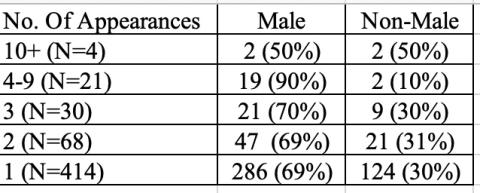
A similar analysis for the gender of Topics shows a slightly reversed pattern with the proportion of male Topics increasing from a level roughly similar to overall representation, to higher levels of male subjects with decreasing frequency of appearance.[3]
Table 21: Repeating Topics by Gender
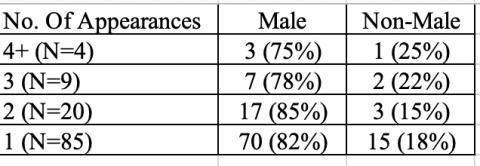
For Topics, it’s easier to also do a comparison across different eras, although it isn’t broken down by repeat appearances due to the small numbers. Male Topics predominate heavily in the first two eras and remain at 2 out of 3 in the most recent era, though this is less male-skewed than the overall named-person dataset.
Table 22: Proportion of Gendered Topics by Era
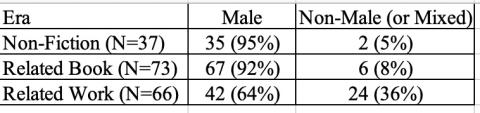
Conclusions
Both as authors and as subjects, the distribution of People follows a typical “long tail” distribution. The types of Categories associated with repeating authors is quite varied, but unsurprisingly corresponds largely to the “most popular” and “more popular” groups. Gender distribution behaves differently for the two functions, with repeat authors skewing male (except at the very highest numbers, thanks to 2 very prolific individuals), while the percentage of male subjects is more balanced for repeat subjects, then skews more heavily male at lower frequency of appearance. In other words, male authors are more likely to get multiple nominations, while non-male individuals are slightly more likely to be the subjects of multiple nominated works, entirely due to the increase in non-male Topics during the Related Work era. This matches other measures of gender balance which shows a shift from male dominance in earlier years to a fairly recent approach to parity.
3.4.3 Properties
Works were tagged for Property when the Topic of a work is a single specific media Property.[4] There were 59 works (10% of the dataset as a whole) tagged for 33 distinct Properties, of which 9 Properties appeared more than once.[5] The Properties appearing more than once are:
- Doctor Who (6)
- Star Trek (6)
- Discworld (5)
- Star Wars (5)
- Lord of the Rings (4)
- Game of Thrones (3)
- Dune (2)
- Harry Potter (2)
- The Hobbit (2)
Six of these originated as print fiction, although the nominated works may concern derivative video material (tv and movie versions), while the remaining 3 originated as video formats.[6] There’s a greater variety of original formats for the full data set, including comics and games, and print-origin works make up slightly less than half of the full set.
The works take a variety of approaches to their Topics. The most common Category was Criticism (15) followed by Reference (11), Art (10), and History (9). Category types with 5 or fewer examples were Essays, Craft, Graphic, Journalism, Reviews, Science, and Role-Playing Game.
For 2 of the repeating Properties, some works were part of an identifiable Series, while the other repeating Properties involved all independent works. Doctor Who had 3 works from the “Chicks Dig” Series and 2 works from Doctor Who: The Writer’s Tale. Discworld had 3 works from the Science of Discworld Series.
Male-only authorship was 58%, non-male only authorship was 34%, while mixed authorship was 5%, showing a slight skewing of authorship towards non-male compared to the dataset as a whole, but this is entirely due to the gender make-up during the Related Work era, where male-only authorship was 35%. In the other two eras, proportions matched the dataset as a whole.
Property-tagged works made up the following percentages in each era:
- Non-Fiction 5% of Finalists
- Related Book 3% of Finalists, 12% of Long List
- Related Work 10% of Finalists, 10% of Long List
In other words, while works about specific Properties appear to be nominated in relatively steady proportions (within the limits of the data set), they have increased in popularity to make Finalist more often in the most recent era. It’s possible that this is related in some way to the expanded format scope, as nearly half of the works in that era (46%) are non-Book formats. If so, the effect would be related to a shift in interest from Books to other formats, as the overall proportion on the Long List is similar to the previous era. It’s also possible that the increased interest is due to some other correlating factor such as author gender.
Only one Property-tagged work has won Best Related: Chicks Dig Time Lords: A Celebration of Doctor Who by the Women Who Love It.[7]
Conclusions
Overall, works related to specific media Properties make up a small but meaningful percentage of nominees, but have only been recognized as Finalists in proportion to their numbers in recent years. The works discuss their subjects through a variety of lenses and using a variety of Media formats. Author gender followed the overall proportions in the earlier two eras but skewed away from all-male authorship in the Related Work era at the same time that interest shifted from Books to other formats.
3.4.4 Other Topics
In addition to tagging works for the Person or Property that is the subject, a reasonable attempt has been made to identify other types of Topic. This may be in addition to a Person/Property tag, in rare cases. Rather than attempting to define a relatively closed set of Topics, the tags have been chosen expansively and only afterwards normalized to combine what are clearly close variants of the same theme.
After excluding works that are tagged only for Person or Property, or which are identified as concerning multiple Persons, or are a multi-genre collection of the work of a single author, the following interesting themes emerge from the remaining 272 works.
A large number (61) focus on specific textual genres, especially the broad genres of science fiction and fantasy, but also including micro-genres such as steampunk, pulp fiction, and the Omegaverse.
Topics related to the process of writing and publishing are also well represented (34), mostly as a general Topic, but including specifics such as magazines, the business of writing, and tropes.
In similar numbers we find Topics related to representation (31), either on the page or from the creator side. Especially prominent are works relating to feminism and the representation of women, racial representation, and disability.
Next we have Topics related to the culture of fandom and conventions (25). Topics on various artistic media (18) include studies or techniques related to specific formats such as movies, graphic art, and anime. Various Topics relate to space (18), including both astronomy and speculative works on space travel and space stations. 15 works focus on the literature of specific countries, regions, or languages. Hard sciences and technology works (14) include factual Science and speculative extrapolations such as robots and futurism.
Topic groups consisting of 5-10 works include myth and legend, gaming, life sciences, industry awards, material culture/artifacts, and several Topics falling generally under philosophy.
There are no overall conclusions to this chapter, given the broad scope of the Topics and the small data numbers.
3.4.5 Publishers
Identifying the Publisher of each work isn’t entirely straight-forward, therefore this discussion is an approximation. Publisher data is taken either from the official Hugo website data or from Wikipedia, Goodreads, or Internet Archive data. But disentangling different editions, different Publisher imprints, and determining whether to lump imprints together under a Publisher—to say nothing about tracking mergers and acquisitions—goes beyond the scope of this project. In some cases, it’s possible that listings have been lumped together as variants on a Publisher name that, in fact, represent different Publishers or different imprints with similar names. There’s also the question of what to identify as the “Publisher” of personal Blogs, Social Media accounts, and YouTube channels.
Given the preceding, the data identifies 294 different Publishers. Only absolute numbers are analyzed, not changes over time. Five Publishers appear 10 or more times:
- Underwood Books (26)—Primarily Art Books, especially the Spectrum Series
- Paper Tiger Books (15)—Art Books
- Tor Books (12)—A variety of content
- NESFA Press (11)—A variety of content, primarily Essay collections
- McFarland & Company (10)—A variety of content, primarily Biography
For Publishers appearing fewer than 10 times, we see a typical “long tail” distribution, indicating that Publisher distribution is relatively random.
Table 23: Repeating Publishers
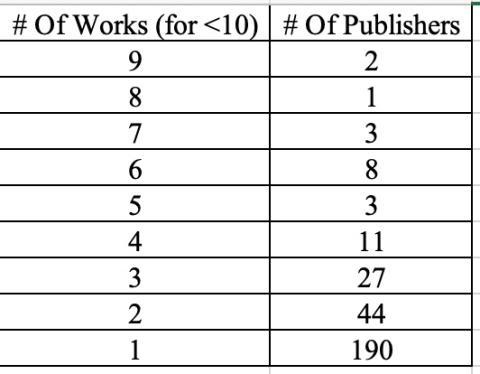
University Presses
One might expect that university presses would be well represented for the more academic works, however they are only a minor fraction. There are 19 different Publishers with the word “university” in the name, representing 48 works. The university presses aren’t limited to the most scholarly Content. In addition to Biography, Craft, Criticism, Essays, History, and Reference works, they also publish Reviews and Interviews. The most common content types not published by university presses are: Art, Autobiography, and Fiction.
Author gender for university press publications is less skewed towards male authors than the dataset as a whole, with 56% all-male authorship, 33% all non-male authorship, and 10% mixed.
No other subsets of Publisher have been analyzed further.
3.4.6 Series
Nominators are fond of following thematic Series of works. In the data set, 93 works (15% of the dataset) are identified as belonging to a Series of publications, representing 37 different Series. (Of which 14 are represented by only a single nominee.) Series with 3 or more nominations are as follows:[8]
- The Spectrum annual Art showcases (17 works)
- The Modern Masters of Science Fiction Series from the University of Illinois Press (6 Biographies)
- The Chicks Dig… Series from Mad Norwegian Press (5 volumes of Essays covering female fandoms of specific Properties)[9]
- The Writing Excuses Podcast (5 years)
- The #BlackSPecFic Report (4 years)
- The Anatomy of Wonder (3 separate editions)
- The Cambridge Companions to Literature Series from the University of Cambridge Press (3 nominees, but two are the same work with an extended eligibility)
- Chinese Science Fiction, An Oral History (3 volumes in various combinations)
- Jim Hines’s Invisible Essay collection Series on marginalized representation (3 years)
- The Science of Discworld (3 volumes)
- Writers of the Future (3 volumes, although one was explicitly ruled ineligible as Fiction and it’s likely the other two would have been as well, if evaluated)
The following Series have two works in the data set:
- Reader’s Guide (genre survey)
- Doctor Who: The Writer’s Tale (insider analysis of the show)
- Dream Makers (Biography collections)
- Faces of… (Photography of figures in the field)
- I, Asimov (Autobiography)
- Liverpool Science Fiction Texts and Studies (both works are histories of pulp magazines)
- Robert A. Heinlein: In Dialogue with His Century (Biography)
- Sandman (Graphic novel)
- Science Fiction, Fantasy, and Horror (annual books in print report)
- Speculative Fiction: The Year’s Best Online Reviews, Essays, and Commentary
- The Encyclopedia of Science Fiction (2 different editions)
- Tropes vs. Women in Video Games (Video Essays)
As seen above, works appearing as part of a Series represent a wide variety of content Categories and (in the Related Work era) Media formats. As such, further analysis would be unlikely to provide meaningful results.
[1]. That is, this represents 23% of the distinct authors, not 23% of the works. Similarly for People-subjects below.
[2]. The more complicated calculation for comparing the different eras hasn’t been performed, but based on the gender fractions per work comparison, we would expect to see a similar gradient with male dominance decreasing over time.
[3]. There are some flaws to using the full set of named people as the reference point, as it assumes that out of a random pool of participants a person is equally likely to be an author or subject of a work. This is clearly not the case, but it would be much harder to identify gender balance in the potential pool of subjects.
[4]. This does not include works where the work is the Property. For example, a critical study of Batman comics would count as Batman being the Property, while the nomination of Batman: The Dark Knight Returns itself does not count.
[5] As with multi-author collections, the Properties mentioned in multi-Topic collections are not individually tagged.
[6] All of these Properties have some video presence, although it isn’t clear that Discworld nominees benefitted from the associated video works.
[7]. The repeated appearance of works in the Chicks Dig… Series inspires one hypothesis for the gender skewing in the Related Work era. Possibly as part of overall gendered trends, non-male authors are more interested in producing fannish Analysis of specific Properties.
[8] Ongoing projects, such as Podcasts or certain types of Websites have not been included as a Series.
[9]. I have included one work in this Series titled Queers Dig… as there doesn’t seem to be a good, simple umbrella label for the whole series.
Major category:
ConventionsPages
